
 +1-281-934-4000
The 2025 construction equipment market symbolized a great change towards efficiency, flexibility, and lifecycle value. Buyers were not as concerned anymore with horsepower or the size of the machine. They instead concentrated on machinery that produced steady output, minimized downtime, and was versatile to various job-site tasks. This was due to the pressure to increase productivity and profitability on projects, the increased cost of fuel, and the growing complexity of the contemporary construction industry.
The market was also influenced by the trends in financing and ownership. Contractors became more strategic in their investments, taking into account the total cost of ownership, utilization rates, and resale value. This spiked the popularity of small and medium-sized machines as the most sought-after equipment in 2015, especially for urban infrastructure, road, and utilities work.
Construction Equipment Market Prospects In 2025
The construction equipment market in the world has now been stabilized after a number of years of rapid growth. The demand is high, and buying habits have tightened. Contractors are giving attention to heavy machinery that is characterized by constant productivity and low risk of operation. The financing institutions are also contributing significantly, as they affect the type of categories that experience the best volumes of transactions.
Small machines dominate the approvals of financing, showing that there is a certain preference for machines that are easy to deploy, move, and maintain. The mid-sized excavators and loaders are still doing well, whereas the large machines are experiencing a selective demand, which is mostly related to infrastructure megaprojects.
The other trend that is important to note is the adoption of digital systems in the purchasing decision. Customers have learned to consider the compatibility of telematics, data on fuel efficiency, and predictive maintenance options before engaging in investments in equipment.
Practical Impact:
The change implies that contractors have to align fleet strategy with actual demand and not size-based expansion.
The Reason Compact Equipment Is A Sales Leader
In 2025, the construction operations will rely on compact equipment. Compact track loaders (CTLs) and skid steers, as well as compact excavators, are also dominating sales charts since they are versatile and cost less to purchase.
One of the largest contributors to this trend is urban construction. The lack of space and stringent conditions, and the precision nature of work, are all in favor of smaller machines, which do not require compromises when it comes to productivity. Moreover, the machines can be used to carry out various tasks using attachments; special equipment is not required.
Financially, compact equipment is less expensive to purchase, consumes less fuel, and presents fewer logistical challenges during transport. These aspects have a great likelihood of enhancing the return on investment, particularly for small to mid-sized contractors.
Practical Impact:
Small machines enable the contractor to undertake several tasks at the jobsite using fewer assets to enhance the efficiency of the fleet and minimize machine idle time.
Top-Selling Equipment Categories
The most popular types of construction equipment to sell in 2025 show the obvious tendency towards versatility and flexibility. Market segments are dominated by the following:
- Compact Track Loaders (CTLs).
- Skid Steer Loaders
- Compact Utility Loaders
- Mid-Sized Excavators are between 13 and 30 tons.
- Motor Graders (Stable demand in specialized infrastructure)
Compact track loaders are the best in the market because they are well-tractioned and can work in all environments. Skid steers continue to be popular due to their capabilities of maneuverability and affordability, and compact utility loaders are becoming popular in the landscaping and light construction industries.
Excavators are still needed as they are multi-purpose tools used in the process of digging, lifting, grading, and demolition.
Practical Impact:
The knowledge of such categories assists the contractors in investing in machines that ensure they are highly utilized in various types of projects.
Technical Specifications And Performing Standards
The result is a generalized specification profile of 2025 based on equipment that is selling well:
| Specification | Best-Selling Range / Details |
| Engine Power | 65 – 175 HP |
| Operating Weight | 3,000 – 30,000 kg |
| Hydraulic Flow Rate | 70 – 180 L/min |
| Fuel Efficiency | 8 – 18 L/hr |
| Travel Speed | 8 – 40 km/h |
| Lift Capacity | 1,000 – 5,000 kg |
| Hydraulic Efficiency | Strong flow control; High efficiency pilot systems; Competitive load sensing |
| Dealer Network | Strong in many markets; Excellent in select markets; Strong service orientation |
| Typical Advantages | Fuel efficiency, tech features; Smooth controls, durability; Operator comfort |
Key Highlights:
- Power-to-weight ratio is high, thus enhancing efficiency.
- Hydraulic flow is optimized to guarantee shortening of the cycle time.
- The fuel-efficient engines lower the operational costs.
- A small footprint increases maneuverability.
Practical Impact:
These standards enable the buyers to compare machines with respect to productivity as opposed to size or preference of the brand.
New Engine And Powertrain Systems
In 2025, the construction equipment engines produced are aimed at compensating for the power output with fuel efficiency and emission standards. A majority of the machines have turbocharged diesel engines that have an electronic fuel injection system.
Key features include:
- Improved efficiency in the variable geometry turbochargers.
- High-end cooling to support load performance.
- Optimized fuel delivery to Electronic control units (ECUs).
Modern powertrains prioritize Electronic Clutch Pressure Control to ensure seamless power transfer. This has optimized torque curves that enable machines to work effectively in different load conditions.
Practical Impact:
Efficient engines and powertrains will decrease the fuel usage and increase the life of the machines, which has a direct effect on profitability.
Hydraulic Systems And The Efficiency Of Performance
The hydraulic systems play a central role in the performance of the machine, particularly in the case of loaders and excavators. Load-sensing hydraulics and variable displacement pumps are also standard features in the most popular models of 2025.
Key advancements:
- Improved response times for high-accuracy control.
- Less energy wastage in the distribution of the flow.
- Improved attachment compatibility
High-flow hydraulic systems are now becoming widespread, and machines are able to have difficult attachments fitted, like mulchers and augers.
Practical Impact:
Productive hydraulics will help in enhancing productivity through lessening cycle times and enhancing precision in operations.
Design Of Transmission And Drivetrain
Modern equipment has transmission systems that are based on durability and easy functioning. Compact equipment is dominated by hydrostatic transmissions, whereas the larger construction machines are dominated by powershift and Continuously Variable Transmission (CVT) systems.
Key characteristics:
- Seamless speed control
- Reduced mechanical wear
- Improved traction management
Components of the drives are strengthened to bear heavy loads and in extreme working conditions, so that there is a uniform performance in various terrains.
Practical Impact:
An effective transmission system reduces downtime and improves operator control, particularly where the requirements are high.
Frame Engineering And Durability
Machine design is very important in the duration of life of machines. The steel is made of high-strength and reinforced joints to resist stress and impact.
Engineering considerations include:
- The distribution of the loads on the chassis.
- Effective torsional strain resistance.
- Safeguarding of strategic elements.
The manufacturers also pay attention to the corrosion resistance and covering in order to increase the service life of the equipment.
Practical Impact:
A long-lasting frame will minimize the cost of repairs as well as guarantee uniform performance throughout the length of the working hours.
Moldboard Systems And Work Tools
Moldboard systems are central to the precise grading performance of motor graders. State-of-the-art designs are better controlled and adjustable.
Features include:
- Hydraulic blade positioning
- Increased curvature to allow the flow of materials.
- Wear-resistant cutting edges
These systems are designed to provide uniform grading output with a minimum of operator input.
Practical Impact:
The effective moldboard systems enhance the quality of the surfaces and minimize the rework in the case of the grading works.
Attachment And Versatility Expansion
Construction equipment is very functional with attachments. Common attachments include:
- General-purpose, heavy-duty Buckets
- Hydraulic breakers
- Augers
- Grapples
- Trenchers
Quick coupler systems enable operators to change attachments very fast, and this enhances machine utilization.
Practical Impact:
Attachments also allow one machine to do various jobs, so it does not require more machines.
Operator Cabin And Ergonomics
The modern operator cabins have been made to be comfortable, safe, and productive. Features include:
- Adjustable controls and seats.
- Climate control systems
- Machine data touchscreen displays.
- Improved visibility by design of optimized cabs.
The technologies of noise and vibration minimize and enhance the comfort of the operators working over long periods.
Practical Impact:
When the operator feels comfortable, he will be more productive and have reduced chances of making mistakes, which will make the jobsite more efficient.
Wear Patterns, Serviceability, And Maintenance
Maintenance accessibility is a primary factor in equipment performance. Best-selling machines are developed to be convenient to access service points and made to be easy in the maintenance process.
Common wear areas:
- Hydraulic hoses
- Cutting edges and bucket teeth.
- Undercarriage components
Alerts and Preventive maintenance systems contribute to the minimization of unforeseen breakdowns.
Practical Impact:
Effective maintenance minimizes unproductive downtime and the long life of equipment, hence maintaining uniform productivity.
Intelligent Technology And Telematics Implementation
The telematics systems are now the norm in the current construction equipment. The systems will give real-time information on machine performance, position, and fuel consumption.
Key benefits:
- Predictive maintenance alerts
- Fleet management optimization
- Remote diagnostics
Mobile and cloud integration will enable the contractors to track the operations everywhere.
Practical Impact:
Telematics enhances better decision-making and minimizes operational inefficiency at the fleet level.
Competitor Comparison And Market Positioning
| Brand | Market Strengths | Market Positioning |
| Caterpillar | Heavy-duty, extensive dealer network | Premium |
| Komatsu | Economical fuel usage, hi-tech equipment | Premium |
| John Deere | Operator comfort, high reliability | Mid-Premium |
| Bobcat | Leadership in compact/small machinery | High Demand |
| Kubota | Innovation in small equipment, affordability | Rapidly Expanding |
Analysis:
- Premium brands are technology and durable-based.
- The mid-tier brands fight on cost-effectiveness.
- Volume sales are controlled by compact-oriented brands.
Practical Impact:
The selection of an appropriate brand has long-term performance, service, availability, and resale value.
Total Cost Of Ownership And ROI Analysis
TCO incorporates purchase price, fuel economy, service, and sale value. The contractors in 2025 are focusing on machines that have a lower cost of ownership.
ROI factors:
- High utilization rates
- Fuel efficiency
- Minimal downtime
Balanced machines that offer good returns in the long run provide the best returns.
Practical Impact:
Concentrating on TCO will keep the investments in the equipment lucrative within its life cycle.
New Vs Second Hand Equipment Buying Guide
New equipment offers:
- Latest technology
- Warranty coverage
- Higher upfront cost
Used equipment offers:
- Lower purchase price
- Faster ROI
- Potential maintenance risks
Buyers have to analyze their budget, project needs, and future objectives and make a choice.
Practical Impact:
The correct decision will be based on the financial plan and the needs of the project, and not a blanket solution.
Domestic Market Environment And Trends
In some parts of the world, such as South Asia and the Middle East, infrastructure construction and urbanization are the factors that drive demand. The use of compact equipment is especially trendy because it is flexible in crowded areas.
The purchasing decisions are also affected by the importation laws, exchange rates, and the availability of funds.
Practical Impact:
The knowledge of the local market dynamics will assist the contractors in making wise decisions when buying and also remaining competitive.
Training And Skills Operator Requirement
High-level equipment needs trained operators who can get the maximum out of machines. The areas that training programs target include:
- Control and safety of machines.
- Efficient operation techniques
- Maintenance awareness
Accidents are minimized through proper training, and productivity is enhanced.
Practical Impact:
Proficient operators improve the work of equipment and reduce the risk of operational errors.
Financing Trends And Sales Distribution 2025
Financing will continue to be one of the major determinants of construction machinery sales in 2025, as it will determine the type of machines to lead the market. According to industry statistics, the percentage of financed machines to overall equipment sales in the United States is approximately 40 to 75 percent, based on the type and price of the machine.
This broad spectrum indicates a varied customer base with a mixture of small contractors who invest in smaller equipment and large companies that buy high-value equipment.
Although there are still buyers who use direct cash purchases or letters of credit, financing remains the preferred choice for most buyers. This is especially on the larger pieces of equipment like large dozers, high-capacity excavators, and high-tech wheel loaders that are of a higher ticket. These machines require a lot of capital investment, and financing enables the companies to maintain their liquidity and, at the same time, purchase the much-needed assets.
The other major reason that has led to the adoption of financing is the flexibility of the loan structure and leasing facilities. The customized solutions that are being provided by financial institutions and financing programs supported by OEM are in line with the project schedules and revenue cycles. This will ease the weight on the finances and help the contractors to increase operations without overstraining their capital bases.
Strategically, the financial power enables the fleet owners to also have a more modern equipment line. Contractors are able to upgrade more regularly instead of keeping old machines, which have low fuel efficiency, outdated technology, and high maintenance costs.
Practical Impact:
Financing helps the contractors to afford high-performance equipment without having to invest heavily in the equipment, and this increases the cash flow and quicker expansion of the fleet.
The Leading Financed Equipment By 2025
The financed equipment units by 2025 distribution shows the definite market preferences and demand trends. Small and multifunctional machines are still the leading ones in financing approvals, which is evidence of their role in the current construction processes.
| Product Category | Units Financed | Percent of Total Units | Percent Change YOY |
| Compact Track Loader | 54,982 | 36.3% | +1.6% |
| Mini Excavator | 33,033 | 21.8% | -5.4% |
| Excavator | 15,672 | 10.4% | -4.1% |
| Wheel Loader | 11,305 | 7.5% | -8.7% |
| Compact Utility Loader | 10,935 | 7.2% | +1.9% |
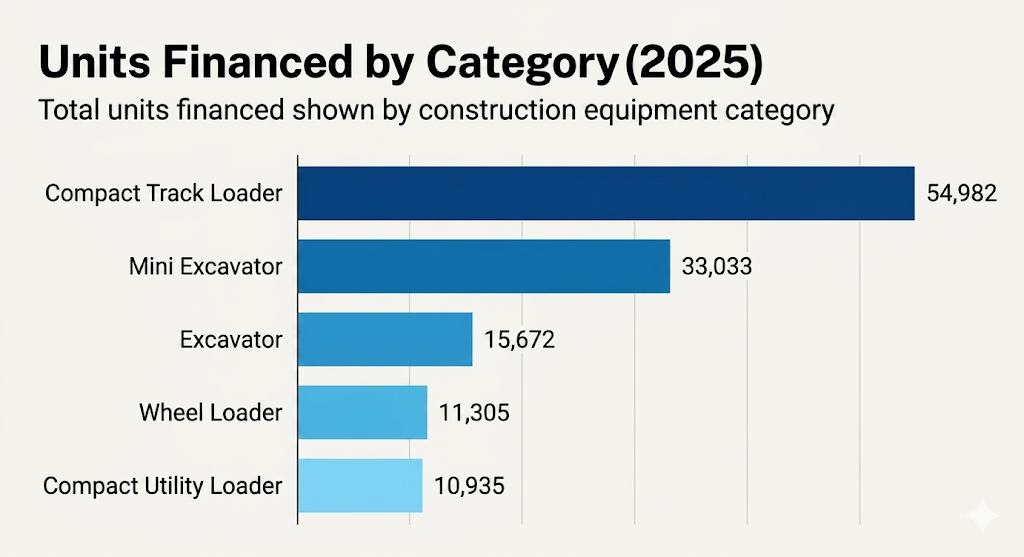
Clearly, the market is led by compact track loaders, which take more than one-third of all financed units. Their steady increase (+1.6% year-over year) is a pointer to high demand due to versatility, high compatibility in attachment, and effective operation in various job-site conditions.
Mini excavators are ranked in the second position, although the year-on-year growth has slightly dropped. This decline is not necessarily an indication that demand is declining, but it is a normalization of high sales in the past few years. The machines are still vital in utility work, trenching, and building urban constructions.
There are moderate declines in standard excavators and wheel loaders, which point to a new trend of smaller and more flexible equipment. Nevertheless, such machines remain extremely important in large-scale projects and material handling processes.
Small utility loaders are on the rise, as they are reinforced by the growth in landscaping, residential building, and light commercial operations. Their development is an indicator of the increased range of compact equipment use.
A 2025 Market Leadership And Manufacturer Rankings
In 2025, the competitive environment of construction equipment manufacturers remains stable, and the presence of the established brands has not weakened due to their good network of dealers, product reliability, and constant innovation.
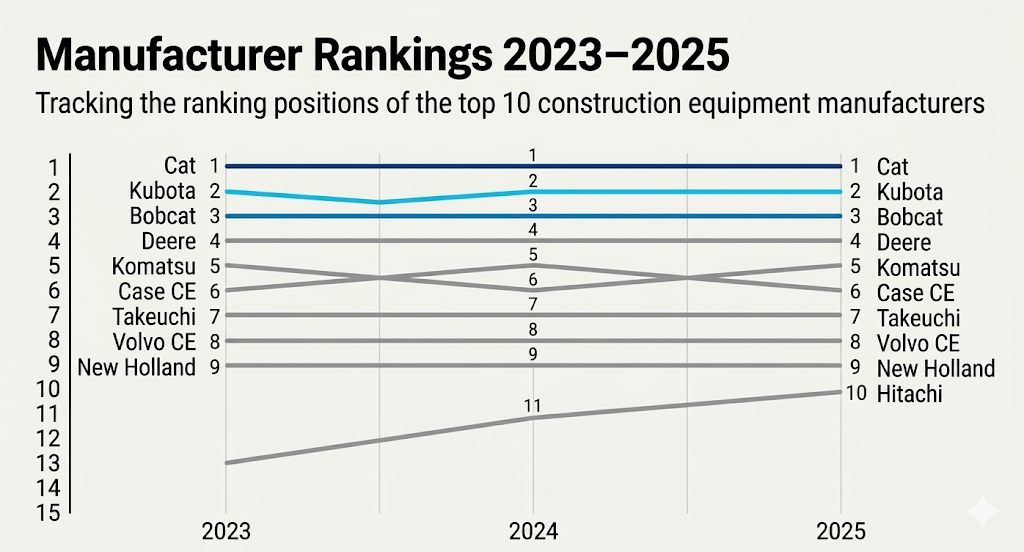
Caterpillar remains a giant in the market, as it has been leading the market for the last three years. It has a competitive advantage in the form of durability of its products, the combination of advanced technology, and the strong network of dealers on the world level.
Kubota and Bobcat retain their good positions since they are leaders in the compact equipment segments. Their machines have been known to be very reliable, easy to use, and cost-effective, hence they have been very popular among contractors.
John Deere is also a major competitor, with a balanced product portfolio of performance, ease of use, and the latest telematics systems. Komatsu has enhanced the company by innovating in the field of fuel efficiency and automation.
Takeuchi, Volvo CE, and Sany are the mid-tier and new brands that still compete with affordable solutions and increase their presence worldwide. In the meantime, other companies such as Toro and Hitachi are advancing on the basis of product differentiation and enhanced distribution channels.
Key Market Insights:
- The leading positions have been maintained, which means high brand loyalty.
- The makers of compact equipment are in control of volume sales.
- New brands are picking up with low-cost pricing.
Practical Impact:
Knowledge of the position of manufacturers will enable customers to select brands that have good support networks so that they can access better services and be reliable in the long run.
The Effects Of Financing Trends On Innovation And Equipment Design
Financing patterns drive both purchasing behavior and equipment design. OEMs are putting more emphasis on machines that are in line with the financing preferences, especially those whose operating costs are predictable and have high resale value.
Strong financing performance of machines is usually characterised by several attributes:
- Maximum fuel efficiency to lower operating costs.
- State-of-the-art performance tracking telematics.
- Maintenance cost-reducing components that are durable.
- Good resale value through the brand name.
Manufacturers are also streamlining machine prices to access the typical financing levels, and it is simpler to get the purchase approved by contractors. This has contributed to the creation of modular designs and scalable configurations, enabling buyers to design machines according to their financial capability and the demands of operation.
The other factor that matters is the technology that is incorporated in the financing decisions. Real-time diagnostics and predictive maintenance systems allow lenders to gain more confidence and minimize risks, allowing the lender to offer more favorable financing conditions.
Practical Impact:
Equipment design is increasingly geared toward financial efficiency, which implies that the contractor is provided with a machine that is both productive and cost-efficient over its lifespan.
Upcoming Construction Industry Growth & Trends in 2026
By 2026, the construction equipment industry will keep expanding at a rapid pace and will be more technologically inclined than ever. The process of digitalization, automation, and AI-based systems began to influence the way machines were maintained and operated. The use of smart fleet management tools by contractors became more commonplace to enhance efficiency and minimize downtime. Simultaneously, electrification and hybrid machinery started dictating new industry trends concerning sustainability and cost savings in the long-run.
Stay connected with MY Equipment for all your equipment needs. If you plan to buy or sell used construction equipment in 2026, visit our website to stay ahead of market trends. Our regularly updated inventory provides complete details on all available units at competitive prices.
FAQs
1: What is the reason why compact equipment is so popular in 2025?
Due to its flexibility, reduced prices, and high productivity in urban and multiple-task job settings.
2: What is the most important factor when buying equipment?
Total cost of ownership – The fuel, maintenance, and resale value.
3: Are used machines investment worthy?
Yes, they can provide good ROI if they are checked and taken care of.
4: Is telematics a significant issue in contemporary equipment?
It is necessary to provide performance checks and minimize downtime.
5: What type of equipment sells the best?
The market leaders are compact track loaders and skid steers.
Don’t forget to subscribe to our YouTube channel for more equipment offers and insights into the industry.
 1400 Broadfield Blvd, Houston, TX 77084,
USA.
1400 Broadfield Blvd, Houston, TX 77084,
USA.
 WhatsApp +1-713-304-6013