
 +1-713-304-6013
Volvo Construction Equipment is taking the most productive technologies down the model range; tools that previously were only available for large machines are now available to midsize wheel loader operators.
Volvo’s OptiShift transmission, automatic quick coupler, and advanced camera systems were long considered to be part of the top end of the wheel loader family. Volvo CE has done just that in a recent series of improvements. With the introduction of the fuel-saving OptiShift transmission as standard equipment, the L60H (formerly the smallest model in the lineup) is the first compact Volvo wheel loader to feature the system.
In addition, the company has begun factory-installing the OilQuick automatic quick coupler system on five models throughout the range and is now introducing Volvo Smart View, a 360-degree bird’s eye camera system, to operators of its largest loaders. The outcome is a lineup that enables the most effective productivity and safety technologies to be found on smaller machines, giving buyers searching for a wheel loader for sale access to advanced features that were previously reserved for larger, premium models.
These changes are being made as the North American construction equipment market faces two challenges: operators look to save on operating costs, and safety standards on jobsites are increasingly difficult to overlook. Volvo is also testing an onboard weighing system in North America that is certified to provide load tickets on the job site, eliminating the need for trucks to travel to public scales.
These advancements are part of one of the most significant developments of wheel loader technology in recent years that Volvo CE has experienced. It’s a comprehensive article on each update, explaining which models it affects, how the technology is implemented, and what it means to anyone considering buying one of these machines today.
Optishift Comes To The Midsize Range: L60, L70, And L90
The most important improvement in this iteration of Volvo CE enhancements is the addition of OptiShift technology to the L60, L70, and L90 wheel loaders. The three machines fill a range between compact utility loaders and full-size production models, and weigh around 24,000 to 38,000 pounds. In the past, OptiShift was a feature only found in the upper range. Today, it is available on machines that are the backbone of many contractors, cities, and light industrial firms.
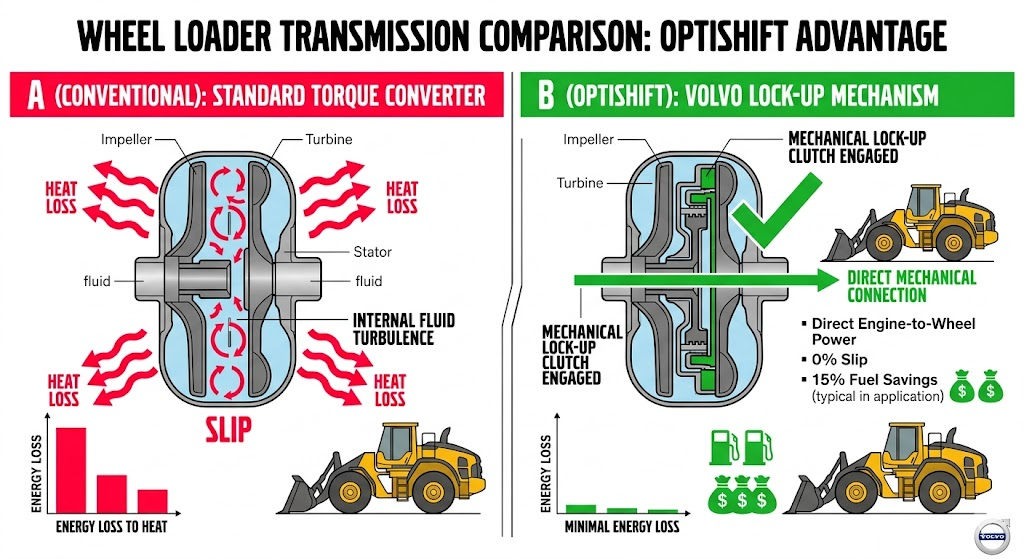
Volvo’s proprietary transmission technology is called OptiShift, and it comprises two separate working parts that combine to create an efficient and productive transmission. These are Reverse by Braking and the next, Reverse by Catching. Where the machine regularly digs into a pile, backs up to a truck or conveyor, dumps, and returns to dig again, the ability to smoothly switch from forward to reverse without lifting the throttle or putting pressure on the brake is a significant advantage in the day-to-day operation.
The second is a torque converter with a lock-up function. When the lock-up clutch is engaged, the torque converter’s fluid coupling is disengaged, and the entire torque of the engine is fed to the wheels via mechanical means. This is more efficient than hydrodynamic power transfer, with no slip, no heat generated, and no loss of energy to fluid turbulence.
When implemented by Volvo, lock-up is automatically engaged in second, third, and fourth gear during the travel phase of load-and-carry operations and long-distance transport cycles. Lock-up can also be manually activated and deactivated, allowing experienced operators to choose when or when not to use the mechanical connection, such as on slopes, on variable surfaces, or in complex duty cycles where the automatic action is not suitable for the task.
Together, these two features are said to improve fuel efficiency by up to 15 percent, depending on the application, compared to machines without OptiShift. The lock-up clutch is most significant in load and carry operations, where the machine is loaded and unloaded at the end of a haul road. The key benefits of short-cycle face loading (Reverse By Braking) are in terms of shorter cycle times and the reduction of stress to the drivetrain, not a simple fuel saving. These are economic values over the useful life of the machine.
Oilquick Automatic Quick Coupler: Factory-Fitted On Five Models
The automatic quick couplers are not new technology in the wheel loader market, but have previously been limited to availability from the factory. There are aftermarket installations, but they add a level of complexity in the field of hydraulic circuit integration, warranty considerations, and calibration. The inclusion of the OilQuick system in five models, the L60, L70, L90, L110, and L120, will have a real impact on the buyer’s mind.
The OilQuick system, as the name suggests, is an automatic attachment connection/disconnection system, which doesn’t require the operator to get out of the cab. It is different from more basic hydraulic couplers in that it automates more. A simple hydraulic coupler is a mechanical connection of an attachment, but it also requires manual connection of hydraulic hoses. OilQuick handles both. All hydraulic supply, return, and pilot lines for attachments that use hydraulic flow are self-sealing flat-face couplings that are built into the coupler head and automatically engage when the mechanical interface locks the attachment frame. The entire process will take seconds.
This is very significant when the construction machines are frequently changing attachments. On a recycling site, a wheel loader with OilQuick could be used for loading bulk material in the morning, for loading bulky waste with a grapple in the afternoon, and for loading trailers with a forklift carriage in the evening. All the changes that used to take seconds or even minutes to stop the machine, exit the cab, disconnect hoses and pull pins, reconnect and re-enter the cab now take seconds, and there is no exposure risk to work around large moving components.
The five models that were represented (L60 to L120) span a wide and commercially relevant range, with the L110 model having a load capacity of 19 metric tons and the L120 model having a load capacity of 20 metric tons. These are the machines that are most frequently used in mixed-duty situations where versatility of attachment is most useful.
Volvo Smart View: 360-Degree Bird’s Eye For Large Loaders
Volvo CE is now introducing Smart View as an optional camera system to the largest machines in the Volvo wheel loader family (L150 to L240, 24 to 39 mto) and will continue to add the system to new machines as they are introduced. It is a 4-camera set-up which creates a virtual bird’s eye view of the machine and its immediate surroundings in real time on the Volvo Co-Pilot touchscreen in the cab.
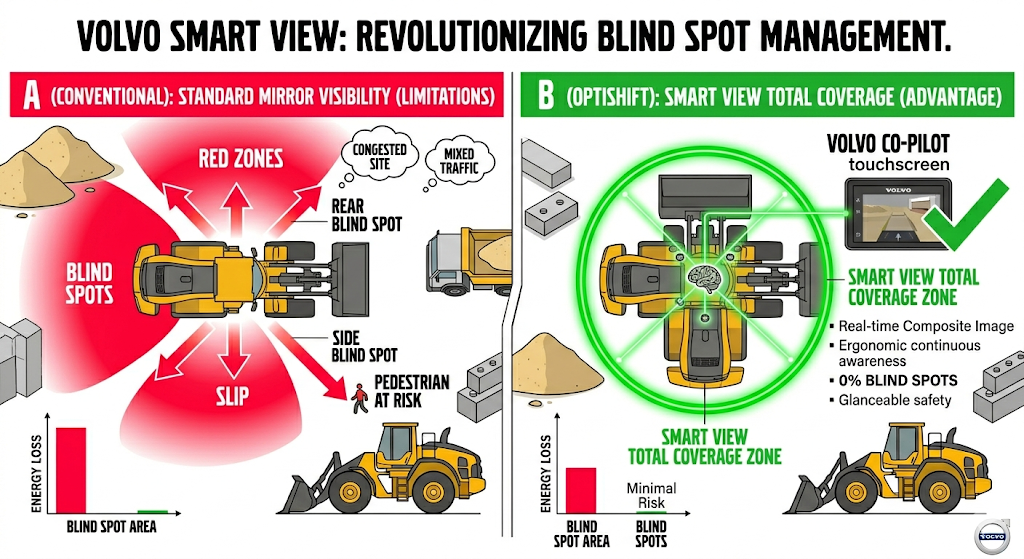
The value of Smart View for large wheel loaders lies in two aspects of their operations. Firstly, the machines in this range are physically large, as the rear corners of the machine are far from the operator’s line of sight, and the rear of the machine when reversing is one of the most challenging areas to monitor. This risk is greatly increased when there is mixed traffic, pedestrian movement, or equipment congestion at the site. Smart View provides the operator with an ongoing, real-time reference of what is behind and beside the machine, and doesn’t need to switch cameras or use mirrors.
True ergonomic improvement is not a camera safety feature, but a system that is able to supply continuous environmental awareness, while the operator is still engaged in the main task.
Certifiable Onboard Weighing: Skipping The Scales In North America
Along with the three main technology updates, Volvo CE is running a trial of a certifiable onboard weighing system in North America that could mark a major paradigm shift in the way material haulage is managed and documented on construction sites. The system provides for the wheel loader itself to create load tickets (official records of the load put into each truck), which can be accepted as a substitute for public weighbridge records.
The North America trial is targeted towards regulatory acceptance of the load ticket system, which is different in different jurisdictions. Volvo CE’s strategy of having a well-defined trial suggests that it is preparing for wider availability when the regulatory route is finalized. This is a development that will be interesting to monitor as it continues with the trial, for buyers who are interested in high-throughput loading applications.
Technical Specifications And Model Coverage
The table below shows which updates are available on which models in the current range of Volvo wheel loaders.
Here is the data formatted into a clean, copy-pasteable Markdown table for your use:
| Model | Weight Class | OptiShift | Oil | Quick Factory Option | Smart View Option | Certifiable Weighing Trial |
| L60H | ~11,000 kg | Now included | Yes | No | TBD | TBD |
| L70H | ~13,000 kg | Now included | Yes | No | TBD | TBD |
| L90H | ~17,000 kg | Now included | Yes | No | TBD | TBD |
| L110H | 19 metric tons | Previously available | Yes | No | TBD | TBD |
| L120H | 20 metric tons | Previously available | Yes | No | TBD | TBD |
| L150H–L260H | 24–39 metric tons | Standard | No | Yes (optional) | TBD | TBD |
Key Highlights By Feature:
- On the L60, L70, and L90 models, OptiShift offers up to 15% in fuel economy benefits, particularly when using the lock-up clutch in load-and-carry applications, which can take advantage of the lock-up clutch’s full travel phase.
- Reverse By Braking is especially useful in face loading cycles where the face loading and dumping distance is short, such as in quarry face loading, stockpile building, and truck loading under a hopper.
- Lock-up can be programmed to come on as soon as gears 2, 3, and 4 are engaged, or it can be manually engaged, providing an experienced operator the flexibility to adjust the way lock-up works based on terrain and load conditions.
- The OilQuick factory fitment is available on the five most common models on the L60–L120 range, while OilQuick aftermarket fitment is still available on L150 and higher models.
- Smart View is aimed at the L150–L260 size category, where investment in the technology is justified due to the risk exposure, site congestion, and machine size.
- The certifiable weighing trial is unique to North America and is a reflection of the complexity of regulatory acceptance of load tickets in each of the state and provincial jurisdictions.
Hydraulics And Transmission: The Architecture Behind The Updates
The OilQuick system and OptiShift enhancements are not standalone technologies, but rather rely on the versatility and quality of Volvo’s hydraulic and powertrain design. Volvo’s load-sensing, pressure-compensated hydraulic system is available throughout the Volkswagen range. In the real world, this equates to the hydraulic pump adjusting its displacement in real time to the amount of displacement that is being used by the circuits that are active. This minimizes the power draw and heat generation of the hydraulic system as a whole, and may be especially significant if the OilQuick coupler is the only hydraulic function operating during a change of attachment.
The OptiShift transmission is a 4-speed, electro-hydraulic clutch-controlled powershift transmission. The lock-up clutch is a wet-plate type clutch that operates smoothly when it is electronically controlled, as opposed to a mechanical clutch, which causes a torque spike when engaged. The integrated retarder, a hydrodynamic braking device built into the transmission, delivers braking torque that is not dependent on the engine and helps to wear out the service brakes during the downhill/in deceleration stages. In high cycle usage, it can have a significant effect on brake component life as well as the cost of maintenance.
Operator Cabin: Ergonomics And Technology Integration
All these technology upgrades end up in the cab, however. The cab design currently under development for Volvo has a focus on the Co-Pilot display system, comprising a colour touchscreen that provides the main interface for the machine information, camera feeds, and system controls. On machines with Smart View, the four-camera composite image will be shown on this screen. Both the status and the control sequence of the OilQuick are available on the same display surface for machines with OilQuick.
The OilQuick control interface is manually operated: attachment adjustments are made via a specific sequence of operations, so that it is impossible to make any changes accidentally when the machine is moving normally. There is a clear indicator of coupler engagement status for operators to ensure secure engagement before traveling or lifting.
Smart View’s image feed on the Co-Pilot display is meant to be glanceable, not for extended viewing. The overlay places the machine graphic in the center, with the stitched camera image as the context, allowing the operator to easily understand the space relationship between the machine and any object in the monitored space. Selecting reverse automatically activates the camera, so that the driver doesn’t have to remember to switch to Camera View when he/she changes to reverse.
Maintenance, Wear, And Total Cost Of Ownership
Each technology installed on a machine becomes part of the machine’s maintenance program. When considering these improvements, purchasers should not only consider the operational advantages, but also the service and wear life.
Although OptiShift’s torque converter lock-up clutch is a precision component, Volvo has extensive field experience with the system as it is deployed on larger loaders. The fluid change and clutch check intervals are standard in Volvo’s maintenance procedures. It is a maintenance advantage as well as a productivity feature, since it helps to reduce wear in the transmission by minimizing shock loading during direction changes, as compared to the conventional brake-and-shift method.
The mechanical locking system and hydraulic flat-face couplings need to be checked at regular service intervals for the OilQuick system. A system’s most-worn component is the flat-face coupling, the self-sealing interface used to join hydraulic lines when they are coupled, especially in dusty or muddy applications where contamination can cause seals to wear in as well. As service items, Volvo and OilQuick offer replacement coupling kits, and as a factory fitment, the system’s hydraulic integration is designed from the ground up to be compatible with Volvo’s specifications, minimising compatibility and leak issues with aftermarket installations.
Competitor Comparison
Here is the requested chart formatted for easy copy-pasting into documents or spreadsheets.
| Feature | Volvo L90H (Updated) | Komatsu WA320-8 | CAT 930 |
| OptiShift / Equivalent | Standard (new) | No lock-up coupler std. | No lock-up coupler std. |
| Auto Quick Coupler | Factory-fitted (OilQuick) | Aftermarket only | Aftermarket only |
| 360° Camera System | Smart View (L150+ only) | Optional (larger models) | Optional |
| Onboard Payload Weighing | Available | Standard | Available |
| Telematics | CareTrack | KOMTRAX | VisionLink |
| Stage V / Tier 4F Compliance | Yes | Yes | Yes |
Competitive Analysis:
- The biggest commercial differentiator of the comparison is the inclusion of OilQuick in L60 to L120. Both Komatsu and CAT provide attachment-change solutions, but neither is the factory-integrated full hydraulic coupling automation standard.
- Volvo’s addition of OptiShift to the L60–L90 class allows these machines to achieve a level of transmission sophistication that rivals are not even able to match at similar price points in their transmissions with a similar amount of lock-up and integrated retarder.
- The competition is fairly level in the field of onboard weighing systems, with both CAT and Komatsu providing capable tools, and in the realm of telematics platforms, too.
- As in the large loader class, where blind spot management is most operationally relevant, the availability of Smart View on the L150–L260 class is a significant differentiator, although some competitors have surround-view options, which are generally available at an additional cost.
- Volvo’s factory OilQuick and the OptiShift cycle speed improvements give the company a compound productivity benefit that no other factory offering from Komatsu or CAT can currently match, at least in the case of multi-attachment operations.
Buying Guide: New Vs. Used And Market Conditions
New Machine Considerations
Those looking at the new Volvo L-series wheel loaders with the updates should take note that the pricing structure within the L60-L120 range signals these machines are in a competitive value set where the technology that is included is as important as the base horsepower. The aftermarket installation cost, which can vary from USD 15,000 to USD 30,000 depending on the size of the machine and the scope of the system, is eliminated with Factory-fitted OilQuick, and the entire hydraulic integration is covered by factory warranty. It’s a simple value upgrade for those who would have ordered an automatic coupler anyway.
The most important difference for those who were considering competing in the weight class in other vehicles is OptiShift on the L60 and L70. Wherever there is a load and carry operation across any significant haul distance, or short cycle loading is a major operation, the fuel and drivetrain wear benefits of OptiShift make it easy to compare the Volvo cost per hour figure against machines that lack the same type of transmission technology.
Used Machine Considerations
There is a secondary market in L60 – L90 Volvo wheel loaders. Pre-update machines are available at lower price points if they don’t have OptiShift. If buyers have price-sensitive budgets, it is important to evaluate whether the application really benefits from OptiShift, such as a light yard or aggregate stockpiling at low speeds, which gains more from the lock-up clutch than a truck loading application that is repetitive over a pad. The following should be considered when evaluating used machines:
- History of transmission service and condition of the torque converter.
- The condition of the cylinder rod and the contamination of the hydraulic system are the reasons for this.
- Tyre shape in all four places
- History of CareTrack telematics services for compliance
- The state of the coupler interface when a coupler was fitted previously (if there was a previous coupler)
- The model year the buyer is interested in, the Volvo dealer support, and parts availability.
Local Market Conditions
Buyers in North America should keep an eye on the progress of the certifiable onboard weighing trial. The value proposition of a new Volvo wheel loader, equipped with the weighing system, increases significantly when the load ticket system is accepted by the regulators in key markets, where it is relevant, such as for aggregate, quarry, and civil earthworks applications. The factory fitment announcement is expected to promote the uptake of OilQuick by OilQuick buyers, who were already exploring the system on their own, in markets where the system is well established, such as Europe. In developing markets, the most important factor is the support depth of the newer electronic and camera systems in the updates, as provided by the dealer.
Operator Training And Machine Familiarization
If the operator doesn’t understand how to use the technology, then they won’t gain its value. This is especially the case with OilQuick and Smart View, which disrupts norms in the sphere of attachment management and spatial awareness. The system transitions to OptiShift more gradually, usually making the experience more intuitive for operators who have been operating machines that feature similar modes, but the lock-up clutch modes are more subtle and require understanding to take the most out of the system.
Volvo CE and its dealer network provide training courses for machine-level updates instead of complete operational recertification. The most important training points for OilQuick are: the coupling confirmation sequence, the situations in which the system must not be operated without further inspections (worn attachment frames, muddy coupler interfaces, non-standard attachments), and the daily inspection of the flat-face hydraulic couplings. Smart View training is based on the concept that the operator is aware of the overhead display, instead of the overhead display being the only source for environmental information.
If you are looking for a used wheel loader for sale, then MY Equipment should be your first choice, as we deal in well-maintained and inspected machinery from renowned brands like Volvo, CAT, and Komatsu at a reasonable price. Visit our website now to get the best equipment service.
FAQs
What are the current Volvo wheel loaders that come with OptiShift?
The L60H, L70H, and L90H now have the fuel-saving and loading benefits of the OptiShift standard.
What is automatically connected to the OilQuick auto coupler?
OilQuick automatically connects the attachment and hydraulic lines and changes attachments quickly without leaving the cab.
Will all Volvo wheel loaders have Smart View?
Currently, Smart View is only available for L150–L260 wheel loaders.
What are the differences between a certifiable weighing system and normal payload monitoring?
A certifiable system is used for legal weight records for compliance and billing, and standard monitoring is for productivity.
Is it possible to fit OptiShift on older Volvo wheel loaders?
No, in most cases, it is not a practical aftermarket modification, and it is built into the transmission.
Don’t forget to subscribe to our YouTube channel for more equipment offers and insights into the industry.
 1400 Broadfield Blvd, Houston, TX 77084,
USA.
1400 Broadfield Blvd, Houston, TX 77084,
USA.
 WhatsApp +1-713-304-6013