
 +1-281-934-4000
The 2008 330DL track excavator is a heavyweight competitor in the middle-class excavation, designed to provide contractors with power and life cycle, as well as maintenance. In this guide, let’s explore the systems, technical specs, maintenance regimes, operating nature, and the economics that are relevant to fleet managers. It is done to ensure that there is one reference that an owner, buyer, technician, or trainer can use to make operational decisions and to optimize life-cycle performance.
The model was intended to be used in general work, trenching, quarry, and heavy utility work, uses that required dependable hydraulic capability and strong undercarriage parts. The 2008 Caterpillar 330DL Track Excavator is a model in a group where the fuel economy, ease of access to components, and similarity of particulars are more important to the overall cost of owning one than brute strength. Knowing the machine on a technical level, engine, hydraulics, powertrain, frame, and controls, would enable you to anticipate maintenance trends and achieve maximum uptime.
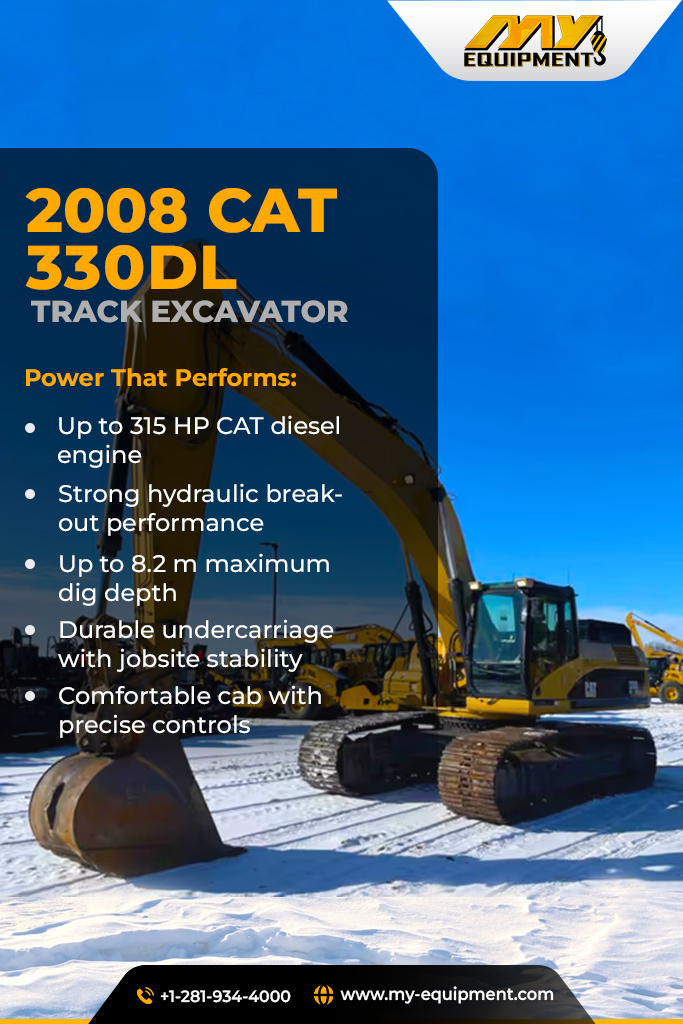
Technical Specifications
- Operating weight: conflicts between 31,000 and 36,000 kg (depends on counterweight, attachments, etc.)
- Engine Model: Cat six-cylinder industrial diesel (factory-selected)
- Net Engine Power: ~185-235 kW (approx. 248-315 hp)
- Capacity of Bucket: 0.9-1.8 m3 (standard buckets).
- Maximum Dig Depth: It has approximately 7.0-8.2 m (depending on boom/stick set-up).
- Boom / Stick Options: These will have a standard and a long reach version.
- Speed: 3.0-6.0km/h/ (Low-High gear)
- Hydraulic System Pressure: 28-35MPa (4,000-5,000 psi)
- Fuel Tank Capacity: 450- 650 L (tank option varies)
- Swing System: Planetary drive, axial piston motor; one of the order of 10-12 rpm.
- Foot Pressure: 3955 kPa (based on the shoe width).
- Undercarriage: Segmented track frames; 600-800 mm of the street width of shoes.
- Standard Attachments: Buckets, Quick couplers, Breakers, grapples
Key Features
- Strong mid-class engine that is driven not to peak horsepower but to torque– prefers recurrent digs and high hydraulic load work.
- The hydraulic system is high-pressure and is designed to operate on numerous tasks at the same time (boom, stick, bucket, auxiliary tool).
- Track undercarriage is constructed to receive any type of shoe width and has replaceable bolt-on components to make the track adaptable in the field.
- Availability to regular maintenance: clustered filters and service stations decrease downtimes to conduct daily maintenance.
- Options offered: thumb, quick-coupler systems, and hydraulic flow package on breakers and pulverizers.
Practical Impact: This familiarity with these base requirements aids in the matching of the machine with the job (excavation depth, bucket size, dozer backup). Misalignment, e.g., incorrect shoe width or too small a bucket, leads directly to less productivity or faster wear.
Engine And Powertrain
Architecture And Behavior of Engines
The engine design of the CAT 330DL track excavator is more focused on the transient response, load, and the torque curve. Anticipate mid-speed diesel with a turbocharger and aftercooler. Depending on the region (pre- or post-tier emissions packages), the emissions hardware and tuning of a 2008 model will be different; the important performance attribute that will be measured is the low-end torque, and how the engine will be able to maintain high torque at low rpm during continuous digging.
Cooling And Air Management
It has a huge, efficient cooling package and a high-flow fan. Hydraulic heat rejection should be matched by cooling capacity – hydraulic loads should not exceed the cooling design because overheating causes the acceleration of component fatigue. Air intake systems have cyclone precleaners; check precleaners and services regularly.
Powertrain System And Drive Plan
A power-split system or central torque converter is an interconnecting system between the engine and the hydraulic pumps and travel motors. The hydrostatic travel motors are usually planetary-reduction type with several gear stages in the final drives. The swing has an independent hydraulic motor with a planetary final drive.
Standard Service Items And Failure Modes
- Fuel system: wear or deposits in the injector leading to poor atomization- Fuel filter needs regular replacement, and the injector should be periodically inspected.
- Cooling: Plugging of radiators or heat exchangers with oil slows down cooling.
- Turbocharger: contamination of oil feed, shaft play- observe smoke and oil consumption.
- Belts and hoses: deterioration due to heat acceleration–change with OEM specification.
Practical Impact: Engine reliability and cooling will dictate whether the machine can be able to operate long shifts due to heavy load on the hydraulic system. The consequence of poor engine maintenance would be loss of digging force and an increase in fuel burn, which would directly increase operating cost.
Hydraulics And Control Systems
Hydraulic Circuit Design
The 330DL track excavator has a variable-flow hydraulic system with load-sensing that varies the flow to the demand to save fuel, but still responds. A series of axial-piston pumps is used to feed the main control valve package, which supplies flow to the boom, stick, bucket, swing, and travel circuits. Proportional flow is supplied to attachments by auxiliary circuits.
Key Components
- Main pumps: variable-speed pumps- axial-piston.
- Control valve: sectional counterbalanced and anti-cavitation valve block.
- Cylinders- chrome-plated rods and forged heads, as well as serviceable gland and seal kits.
- Filtering: return filters and charge filters of high efficiency; filters that require maintenance.
Performance Characteristics
- Parallel use: system monitored to permit various functions without excessive slowdowns.
- Efficiency: load-sensing minimizes the parasitic losses in the partial-load operations.
- Pressure relief and safety Systems: relief valves that are installed in the factory safeguard the actuators and pipeline.
Normal Service And Maintenance
- Internal pump wear- loss of flow or creeping functions. Symptoms: slow recovery of the boom, decrease in the speed of digging.
- Valve leakage Control drift, spongy controls. Check the spool and pilot pressure.
- Hose and fitting fatigue – outer leak; have any correct method of crimping and torque.
Maintenance Periods And Inspections
- Hydraulic fluid: visual and particulate-check inspection daily; regularly change all fluid fully according to hours (usually: 2,000-4,000 hours based on type of fluid).
- Filters: primary and return filters replaced periodically – not to exceed OEM.
- Oil test: The oil samples are periodically tested by spectrometry to identify wear metals and contamination.
Practical Impact: An effective hydraulic can be applied to accelerate the cycle time and increase the multi-function operation control. Weakly maintained hydraulic systems decrease productivity and speed up both hydraulic and structural wear.
Frame Design, Transmission, And Undercarriage
Travel Drive And Final Drives
Travel motors are most commonly two-speed planetary axial piston motors with planetary final drives. These permit adequate tractive effort when loaded and have variable load speed. Planetary gear wear and final drive seals are some trouble areas that need routine inspections.
Car Undercarriage Design And Variants
The excavator will have modular undercarriage assemblies with the option of shoe width and carrier roller configurations. Wider shoes minimize the pressure applied to the ground and slow the rate of traveling slightly, but enhance the flotation on soft surfaces.
Frame And Structural Contemplations.
Frame design makes use of box-section track frames that are welded and reinforced with load-bearing junctions. Boom foot and swing bearing access are meant to be used for doing overhaul work. Find points of stress at boom foot, swing bearings, and main frame junctions–they must be examined for cracks in them during major services.
Patterns of Wearing and Indications
- Track wear and pin-bushing elongation: an indicator that the chain has sagged and has lost the ability to increase tension using a pin.
- Sprocket tooth wear: hooked teeth are an indication of too much abrasiveness or misplaced tension of the track.
- Idler and roller seal failure: results in internal contamination and also causes roller bearing failure.
Service and Replacement Insight
- Track tension: as per OEM spec. Bushing wear is accelerated by over-tensioning and derailing, and increased wear is caused by under-tensioning.
- Rebuild using roller and idler: It is better to replace them in stages in order to prevent different wear surfaces.
- Final drive care maintenance: test gearbox oil in terms of metallic presence through oil assessment.
The implication of this in practice is that the cost of undercarriage in tracked machines can represent a significant part of the lifecycle. Proper shoe width and tension, as well as regular periodic inspections, are critical to controlling TCO.
Boom, Stick, Moldboard, And Attachment Systems
Boom And Stick Geometry
There are two standard and long-reach variant sticks. Longer sticks offer an opportunity to reach and dig deeper at the expense of less breakout force. The pin size and bush size on the 330DL are large enough, yet adequate greasing intervals are essential to maintain the fit and minimize fatigue cracks.
Dawers (Dozer Blade) Systems
The dozer blade mounted on the front is the moldboard (front-mounted), and it is used as a stabilizer with grading and backfilling. Checks Blade linkage, pivot pins, and hydraulics for leaks and play. The capacity of the blade is small in comparison to dedicated dozers, but it is useful on clean-up operations.
Attachment Compatibility And Auxiliary Hydraulics
Common auxiliary circuits are hydraulic, which may have a breaker, thumbs, shears, and rotating grapples. Quick coupler systems are helpful to productivity, yet present new inspection points that include locker pin wear, integrity of the locking pins, and secondary locking systems.
Best Practices of Attachment Management
- Hydraulic flow and pressure to the tool manufacturer’s requirements.
- Take into account flow-diverter valves and pulse-limiter settings of impact tools.
- Locking and inspection of faces of connections are performed every day during the change of tools that are used frequently.
Practical Implementation: The right choice of attachments and the effective strategy of the quick coupler make the excavator a multi-purpose machine. Failure to perform checks on couplers or incompatible hydraulic settings results in damage to tools and a reduction of safety.
Controls, Ergonomics, And Operator Cabin
Cab Construction and Safety
The operator cabin of the 330DL has ROPS/FOPS protection and a logical control layout. The visibility of the glasses, the location of the mirror, and the functionality of the heater and AC will have a direct impact on the comfort of the operator, their safety, and the productivity of the long shift.
Controls And Interface
Proportional hydraulics driven by joystick controls have pilot circuits. Travel pedals or levers, engine and hydraulic parameters multifunction monitor, and rudimentary high temperature or low oil pressure alarms are expected. HVAC systems are present that are simple yet serviceable, and adjustable seating is essential in reducing fatigue.
Ergonomics And Human Factors
- Seat: shock-mounted, including fore/aft and lumbar support adjustment.
- Controls: linear control response is predictable, and it has a small deadband.
- Visibility: the reduced visibility on the left and to the rear should be reduced with camera choices in places where possible.
Practical Impact: Comfort in the operator and ease of navigation lead to a reduction in mistakes in cycle-time, prevent errors caused by fatigue, and enhance the safety of occupying the jobsite. Comfortable work environment and training can give quantifiable returns in terms of productivity.
Service Intervals, Maintenance, And Wear Patterns
Day-to-day, Weekly, and Periodical
- Daily inspection of the visual view, control of the level of liquids (engine oil, coolant, hydraulic), tension of the track, and greasing of major pins.
- Weekly air filter inspection, battery terminal, and fastener spot of torque inspection.
- Periodic (250-500 hours): changes in oil and filters (engine), inspection of hydraulic filters.
- Major service (2,000-4,000 hours): change of hydraulic oil, planning of engine overhaul, and final drive.
Best Practices of the Preventative Maintenance
- Use wear items (pins and, seal,s and filters) with parts that are OEM or OEM-equivalent.
- Keep a digital record of service log data of oil analysis and component changes.
- Replace rubber hoses periodically, instead of failure, in case of harsh conditions.
Ordinary Wear Marks and How to Cope with Them
- Pin and bushing wear: high-abrasion conditions demand increased frequency of greasing and even abrasion-resistant bushings.
- Wear due to cavitation in hydraulic pumps- This is a result of air ingestion- inspect suction lines and charge pump operation.
- Blockages of the cooling system: this happens when the radiator fins are blocked with dust in dry areas. Place screen guards on and schedule regular cleaning.
Checklist of Pre-Purchase Inspections (high-level) of service
- Engine compression test: consistency, load, smoke, engine oil, and condition.
- Hydraulics: external leak check, function speed, and creep test.
- Undercarriage: assess chain pitch stretch and that of shoes.
- Structural: inspection of welds inspector boom, inspection of frame cracks, and swing bearing play.
- It has an electrical gauge cluster with warnings and voltage.
Practical Impact: The number of strict maintenance disciplines is the most significant lever to increase the working life and minimize the lifetime cost. Total preventive replacement of wear-prone parts prevents devastating downtimes, which can halt whole projects.
Technology Systems And Diagnostics
On-board Diagnostic and Monitoring Tools
The instrument cluster is a common feature of the 330DL, with engine hours, fuel, coolant temperature, and warning codes displayed on the cluster. The parameter monitoring, event logs, and fault code reading may be performed at dealer-level diagnostic interfaces.
Fleet Management (Optional / Retrofit) Telematics
Although an excavator from 2008 will not be delivered with even the most basic telematics solutions, most of the purchasers of a used track excavator for sale prefer to install some of the retrofit solutions they find trustworthy. Such systems offer fuel usage, geofencing, idle-time, and simple preventive notifications. Telematics enhances the scheduling of maintenance, minimizes needless idle fuel combustion, and assists in minimizing the risk of theft, so they are a viable upgrade to older machine models.
General Electric Problems and Solutions
- Sensor drift: sensor drift can be intermittent, temp/pressure sensor- compare to real results.
- ECM faults: anomalies in the communication buses are frequently wiring-based before the malfunction of the module.
- Software updates: update module software to manufacturer releases when needed in order to keep the systems in their original state.
Practical Impact: This is due to the effect of effective diagnostics, which reduces the average time to repair and support predictive maintenance strategies. Telematics transforms the raw hours into viable efficiency changes and assists in justifying the allocation of the fleet.
Competitor Comparison
The following is a mere comparison table of where the 330DL fits in with others in the market. To be more precise, I enumerate one representative competitor among each of the key makers.
| Feature | Komatsu Ltd. | Hitachi | John Deere | 330DL (Typical) |
|---|---|---|---|---|
| Operating Weight | Similar mid-30 tonne class | Similar mid-30 tonne class | Similar mid-30 tonne class | ~31–36 t |
| Engine Power | Comparable horsepower | Comparable horsepower | Comparable horsepower | ~185–235 kW |
| Hydraulic Efficiency | Strong flow control | High-efficiency pilot systems | Competitive load sensing | Industry-class load sensing |
| Dealer Network | Strong in many markets | Excellent in select markets | Strong service orientation | Very strong global parts network |
| Typical Advantages | Fuel efficiency, tech features | Smooth controls, durability | Operator comfort and aftermarket | Balanced serviceability, wide parts support |
Comparative Analysis
- Komatsu: can be a good match on fuel efficiency and electronics, select whether you want to route-to-parts and service in your region or not.
- Hitachi: known as having a smooth hydraulic feel and operator comfort, good in areas where the precision of a trenching tool is needed.
- John Deere: will focus more on operator comfort and built-in manufacturing support; good in the areas where there is good dealer coverage.
- 330DL: usually triumphs on the availability of parts and easy service, a practical option for mixed-use fleets.
Real-Life Implication: Competitor disparities are usually regional and dealer-specific. Local support networks and the availability of parts are as important as the basic machine specifications in making the best decision.
Total Cost Of Ownership And Return On Investment
TCO Components To Track
- Depreciation and resale value.
- Real operating cycle fuel consumption.
- Normal servicing and big services.
- Cycle one replacement of the undercarriage.
- Downtime expense and rental/ backup units.
Determining the ROI of A 330DL in a standard application as a contractor
- Set point: mean productive working hours per day, cycles of buckets per hour, fuel consumption/hour.
- Factor: utilization machine productivity and percentage uptime.
- Major overhauls (cost and timing) were planned in the project.
- Fee projected years/hours expected resale value.
Cost-Reduction Strategies
- Optimize the fuel consumption by training the operators and by adjusting the machine settings (eco mode, idle shut down).
- Introduce a condition-based service based on analysis of oil and telematics.
- Select the right attachments to minimize the cycle times (proper sizing of buckets).
Practical Impact: TCO analysis matches the choice of computers and practice of operations to profitability. Minor variations in efficiency or unavailability have disproportionate consequences on margins throughout the existence of an asset.
New Vs. Used Buying Guide Inspection Checklist
New versus Used
- New: warranty, most recent emissions and electronics, less uncertain service costs at increased capital outlay.
- Used (2008 model): cheaper to buy, but with a changing remaining life, may require retrofit (telematics), and unknown maintenance history.
Pre-Purchase Inspection Checklist (Used Units)
- Engine: warming at temperature; observation- smoke, oil pressure, and unusual noises.
- Hydraulics: full-function test; do not expect lag, drift, or slow return.
- Undercarriage: assess pitch elongation of chains of measure shoes, estimate life expectancy.
- Structural: non-destructive inspection of weld cracks at the weld foot, stick, and frame.
- Service Records: confirm change of fluid schedule, any reported repairs, and OEM recalls done.
Negotiation Points
- Include the cost of future significant services in the purchase price of purchase (e.g., final drive rebuild, boom bush replacement).
- Request for the recorded hours and logs of the services.
- Take a short-term service contract to cover up present problems.
Practical Impact: Diligent scrutiny and a stringent approach to valuation keep the buyer safe from unexpected capital spending. Tens of thousands in unexpected repair charges can be spared by preparation on these points.
Best Practices In Training And Productivity Of Operators
Core Training Topics
- Economy/productivity modes and modes of setting them.
- Correct bucket dimensioning and excavation for better cycle times.
- Checks in a day and basic field troubleshooting to prevent cascading failures.
Innovative Training And Metrics
- Telematrics coaching in a fuel-efficient manner.
- Machine-to-machine connection- working with trucks, graders, and crush plants to reduce the travel and repositioning time.
- Attachment optimization: hydraulic settings matching tools.
Accident Prevention And Safety Training
- Excavation around utilities: plan interpretation and the utilization of detection equipment.
- Hydraulic and electrical lockout/tag out.
- Appropriate binding and fixation of attachments.
FAQs
Q1: How frequently is it possible to replace hydraulic oil?
A: The average time is 2,000-4,000 hours, depending on the type of fluid and the environment in which it is being used; the best way to determine the interval that should be used in your application is by doing an oil analysis.
Q2: Should a 2008 heavy machinery be retrofitted with telematics?
A: Yes- in the case of fleet owners. Telematics are remunerated with reduced idle time, enhanced utilisation, and proactive maintenance, which does not involve downtime.
Q3: Which are the items I should focus on when a pre-purchase test run is being done?
A: Spielactive operation through working speeds, engine behavior during loads, swing and travel responsiveness, and a complete inspection of the structural integrity of weld lines to check for structural leakage.
 1400 Broadfield Blvd, Houston, TX 77084,
USA.
1400 Broadfield Blvd, Houston, TX 77084,
USA.
 WhatsApp +1-713-304-6013