
 +1-281-934-4000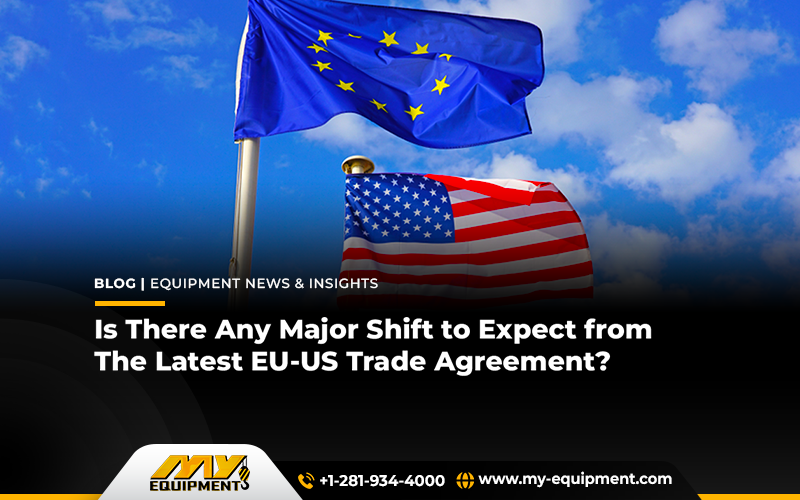
The trader agreement is one of the hot topics in international media that is not only making headlines but also grabbing people’s quick attention.
These tariff agreements have influenced almost every sector in the world, which is further getting complicated with newer editions.
This time a new agreement between Europe and the United States has been signed on July 27, 2024, which is again a topic of discussion in the mainstream media.
But we are concerned about the effect of this new agreement on the construction and equipment sector.
Let’s break it down. What are the main points in this new agreement?
The construction cost is still under pressure apart from all the stabilization
The positive takeaway is that this agreement brings an end to a long period of trade uncertainty. Despite the fact that we are not at the brink of a full-fledged trade war, tariffs remain high. Steel and aluminum products—two key materials used in everything from framing to heavy equipment manufacturing—will continue to face import duties of up to 50%, depending on the product type and origin.
This may result in ongoing price fluctuations and tighter margins for contractors or dealers who source specialty materials or European-built machines. Whether you are dealing with structural steel, construction-grade glass, or advanced lifting equipment, expect pricing and availability to remain volatile. In other words, while there is more predictability now, the cost pressures have not decreased significantly.
New demands for energy and defense spending may increase
Interestingly, while the deal may increase costs, it may also create new demand for infrastructure. In the next three years, the EU has committed over $750 billion in energy imports from the United States, as well as another $600 billion in military and industrial investments. Although full project details have not yet been released, it is safe to expect an increase in activity around LNG terminals, transmission lines, grid expansions, and defense-related manufacturing.
This level of spending is likely to lead to more tenders and project bids in the US infrastructure sector. This agreement may open up new opportunities and strengthen demand pipelines for contractors in engineering, procurement, and construction (EPC) roles, particularly those with capabilities in power generation, logistics facilities, or defense production.
Niche segments can get much benefits from this tariff agreement
While the agreement’s primary focus is on broader trade normalization, it does contain a few zero-for-zero provisions that are worth noting. Certain categories, such as semiconductor equipment, aerospace components, and select raw materials, have been completely exempt from tariffs. These aren’t core building materials, so they won’t matter much to most general contractors, but companies involved in high-tech manufacturing or energy infrastructure may see some benefits.
For example, if you are working on a project that requires imported European automation systems or specialized plant components, they may now be less expensive. It’s a small window, but for contractors working on complex industrial or power-related projects, it could provide some additional flexibility.
It‘s time for contractors to review their sourcing plans
The agreement will be implemented gradually, with the first changes going into effect on August 1 via executive orders. More details on implementation and exemption criteria are expected soon, so contractors and suppliers should reconsider their sourcing strategies. If your operations rely heavily on EU-sourced materials or machinery, or if you are positioned to benefit from defense and energy infrastructure spending, you must closely monitor how this agreement unfolds.
In short, the agreement isn’t a game changer for construction just yet, but it does alter the playing field. While input costs from Europe remain high, the long-term potential for EU-backed investments in US energy and defense may result in new projects and increased demand for specialized services. And, as always, those who stay informed and adapt quickly will most likely come out ahead.
 1400 Broadfield Blvd, Houston, TX 77084,
USA.
1400 Broadfield Blvd, Houston, TX 77084,
USA.
 WhatsApp +1-713-304-6013