
 +1-281-934-4000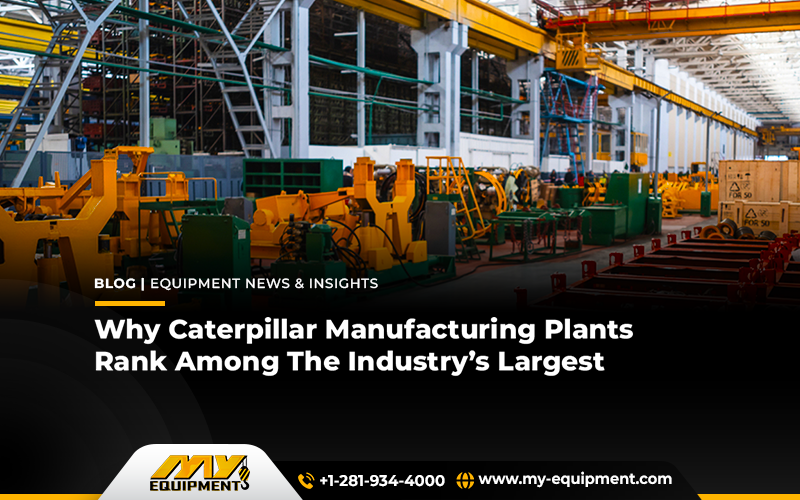
Caterpillar is a company that works on a large scale, such that few companies in the heavy equipment industry can today. Its plants can serve the global demand without having to utilize one production center. The facilities form a network, and each will aid in the efficient flow of machines in production to delivery. This structure is massive in terms of space and the requirement of physical space, logistic coordination, and uniformity of production across the regions. The magnitude of these plants indicates the accountability of fulfilling the global equipment requirements without failure or postponement in dynamic market conditions.
Plant Design: The Focus Is On Flow And Efficiency
The reason plants of Caterpillar become large in size is due to their design, based on continuous movement as opposed to segmented production. The materials move in, change, and proceed through every stage and do not need to be handled unnecessarily or congested. Space enables free flow of fabrication, machining, assembly, and finishing. This design minimises internal bottlenecks and eliminates production slowdowns. Even large facilities simplify the issue of dealing with complex workflow and keeping the speed, accuracy, and safety during the work every day.
Multi-Stage Production Requires The Physical Scale
The construction of heavy machinery involves several different steps, which cannot be performed independently. Every stage requires a specific area, special equipment, and conditions to work properly. These steps should be linked in sequence in order to have a continuous production flow. The more sophisticated the machines are, the more testing and calibration procedures are required, occupying more space. Plant growth is also required to accommodate this stratified process without impairment of output and uniformity in Caterpillar plants.
Automation Increases Capacity Without A Loss
Automation is very significant in the expansion of plants and production efficiency. Automatic material management systems, digital monitoring devices, and robotized systems need space in order to perform their tasks effectively. These systems enhance throughput and have very strict precision standards. The bigger plants enable Caterpillar to absorb automation in order to avoid interfering with the human processes. Scale is not substituted with automation. It works optimally when there is an ability to support volume and complexity at the same time in facilities.
Quality Control Determines Size Of Facility
Caterpillar makes sure the quality of new equipment is incorporated in all levels of the production process, and not only at the end of production inspection. Every machine has several inspections and checks, which increases the overall size of the plants. Special testing zones, inspection check lines, and verification zones ensure that when the equipment is out of the facility, it is up to high standards. This has been the case even when the machines are already worn out and used heavy equipment, as their quality remains high and a predictable performance is maintained, and the buyers are confident it will last long. Throughout production, Caterpillar has ensured the reliability and the reputation of its machines by incorporating quality in all its activities.
Supply Chain Integration Occurs Within The Plant
Caterpillar minimizes dependence by incorporating supply chain operations at its factories. The on-site storage, components staging, and internal logistics offer continuous assembly. It enhances physical demands, but the stability of production and accuracy of the schedules are improved. The movements of parts are reduced and kept tight. These internal systems will operate efficiently within large facilities, eliminating external delays and congestion.
Plants Continue To Grow Due To Future-Ready Planning
Caterpillar has long-term expansion in the planning of its manufacturing plants. Plants accommodate emerging technology, new platforms of equipment, and shifts in regulations. There is space where upgrades can be done without interrupting ongoing production lines. Plants are prepared to undergo transition through training areas, digital infrastructure, and flexible layouts. The size will be a strategic benefit as opposed to surplus size. These plants indicate anticipation of the future demand rather than a response.
 1400 Broadfield Blvd, Houston, TX 77084,
USA.
1400 Broadfield Blvd, Houston, TX 77084,
USA.
 WhatsApp +1-713-304-6013