
 +1-713-304-6013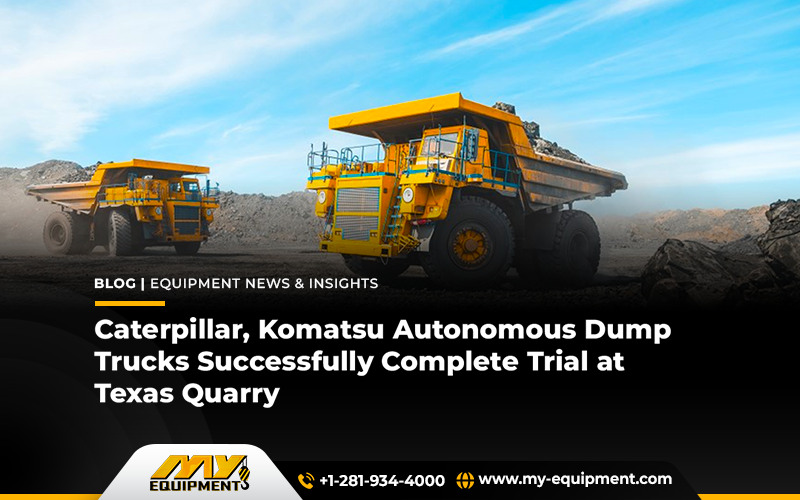
A limestone quarry in Bridgeport, Texas, just became the site of something the construction equipment industry had never seen before: a fully autonomous, mixed-fleet haul operation running Caterpillar and Komatsu trucks side by side, guided entirely by a single self-driving system.
The trial was conducted by Heidelberg Materials, one of the world’s largest producers of construction materials, along with Pronto, a U.S. autonomous vehicle technology company. And in just over eight months, the self-driving trucks moved more than 2 million tons of limestone around the quarry, with no driver behind the wheel.
The results were so compelling that Heidelberg has now committed to deploying more than 100 self-driving vehicles across its global operations by the end of 2028.
What went down at the Bridgeport Quarry
Pronto describes the Bridgeport pilot as North America’s first fully autonomous mixed fleet quarry operation. That’s an important distinction, because most of the autonomous haulage systems available today are built to work with a single manufacturer’s equipment. But Pronto’s system was designed differently; it was built to work across brands.
The trial used Caterpillar 775G and Komatsu HD605 rigid-frame dump trucks at the same location, running by the same autonomous system at the same time.
No issues were running the two types of trucks together, showing you don’t need to have a uniform fleet to operate autonomous haulage. That is a significant finding for quarry and mining operators with mixed equipment on their sites.
The Pronto Autonomous Haulage System uses advanced sensors, cameras, and artificial intelligence to control haul trucks in what the company calls complex, dynamic environments. The system is aftermarket, which means it can be retrofitted to existing trucks rather than operators having to buy a whole new fleet.
Heidelberg is driving ahead with autonomous equipment
Heidelberg Materials is not slowing down after the Bridgeport success. The company aims to have 30 autonomous vehicles deployed by the end of 2026, with a full deployment of 100 vehicles planned for 2028. The expansion will include sites across North America, Australia, and Europe.
The next U.S. deployments are confirmed. Next are Heidelberg’s locations in Mitchell, Ind., and Servtex, Texas. Autonomous hauling deployments are also planned for quarry sites in New South Wales and Western Australia. The company also plans to test an autonomous wheel loader at a sand and gravel operation in northern Germany, expanding the technology from haul trucks alone.
Axel Conrads, chief technical officer at Heidelberg Materials, was candid about the company’s reasons for looking this way. He cited operational efficiency, safety improvements, sustainability targets, and the ongoing challenge of recruiting and retaining skilled equipment operators.
The last point is one that will ring true for many contractors and site managers. It’s getting tougher to hire skilled operators, and retention is becoming a real cost centre for many operations.
Pronto has been gaining momentum fast
Pronto started in 2018 with a simple mission: to make autonomous haulage practical, affordable, and accessible to operations of all sizes, not just the biggest mining companies in the world.
The Bridgeport trial is the most visible manifestation of that vision so far, but the company has been making big moves on multiple fronts in the past year.
Pronto signed a deal in August 2025 with Komatsu to integrate its aftermarket system with the Smart Quarry Autonomous platform of Komatsu. Under that deal, the technology can be retrofitted onto existing Komatsu haul trucks or factory-fitted on new models right from the manufacturer.
Then, in April 2026, Atoms bought Pronto, which became the core technology engine of Atoms’ newly formed mining division. The acquisition provides Pronto with significantly more assets to scale and further develop the technology.
What This Means for the Equipment Industry
Autonomous haulage is not a research paper topic anymore. It’s working on real job sites, moving real material, and the companies are scaling up.
For the broader used construction equipment market, this sort of development raises a longer-term question: as automation becomes more common on bigger sites, how does that change the demand for conventional manned equipment? For now, compact and mid-size equipment used in residential, civil and utility work is nowhere near this kind of automation. Contractors will still rely on traditional used heavy equipment for years to come for standard job sites.
But for large scale quarry and mining operations, the message from Bridgeport is clear, mixed fleet autonomous haulage is effective, it scales, and it’s coming to more sites.
Looking for a used Caterpillar, Komatsu, or Volvo machine for your next project? MY-Equipment has a large inventory of well-maintained used construction equipment located in Houston, Texas. Browse our current inventory or contact our team – we will help you find the right machine at the right price.
Don’t forget to subscribe to our YouTube channel for more equipment offers and insights into the industry.
 1400 Broadfield Blvd, Houston, TX 77084,
USA.
1400 Broadfield Blvd, Houston, TX 77084,
USA.
 WhatsApp +1-713-304-6013