
 +1-713-304-6013
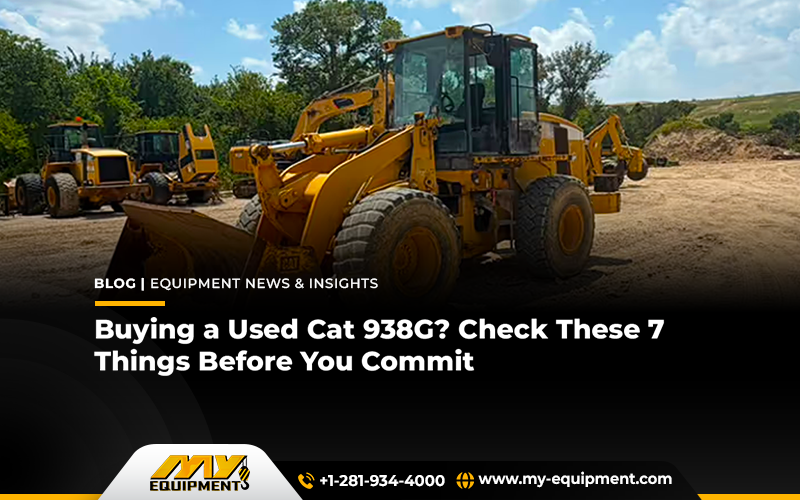
That cheap Cat 938G can turn into the most expensive loader you own. A transmission fault, a worn articulation joint or an engine that runs hot often shows up only after delivery, when the price is already settled. If you are comparing used front end loaders for sale, the asking price is only where the checking starts.
This guide covers seven checks to run before you sign: records, engine, drivetrain, hydraulics, frame, tires and brakes, and cab. It also lists the red flags that mean you should walk away and how to estimate repair costs before you negotiate.
What Should You Check First on a Used Cat 938G Wheel Loader?
Start with the serial number, the model, and the maintenance records. Then go through the engine, transmission, hydraulics, articulation joint, tires, brakes, and cab. Run the loader cold and again when it is warm, and bring an independent technician if you can. A technician can measure wear and read fault codes, which a seller’s description can’t.
Cat 938G Series II at a Glance
| Spec | Figure |
| Engine | Cat 3126B |
| Power | 119 kW (160 hp) flywheel, about 180 hp gross |
| Operating weight | About 30,800 lb (13,980 kg), varies with bucket and tires |
| Bucket capacity | About 3.0 yd³ (2.3 m³) heaped, 2.6 yd³ (2.0 m³) struck |
| Breakout force | About 28,300 lb |
Specs vary with serial number, bucket, and tires, so confirm the configuration of the exact machine you are looking at. Source: Ritchie Specs.
The 7-Point Inspection Checklist at a Glance
| Check | What to look for | Walk away if |
| 1. Serial number and records | Plate matches the paperwork; hours match the wear | Records conflict with the machine |
| 2. Engine and cooling | Cold start, smoke, leaks, stable temperature | The engine overheats |
| 3. Transmission and axles | Every gear, cold and hot | It slips or will not engage a gear |
| 4. Hydraulics and linkage | Smooth lift and tilt, no leaks, tight pins | Scored rods or heavy play |
| 5. Articulation joint and frame | Worn pins, cracks, odd welds | Cracks or impact repairs |
| 6. Tires, rims, and brakes | Even tread, sound rims, brakes that hold | Brakes are unsafe |
| 7. Cab, safety, and working test | Belt, horn, alarm, lights, real loading cycle | Safety systems fail |
1. Verify the Serial Number, Model, and Service History
Match the identification plate and serial number to the seller’s paperwork and the ad. The 938G and the 938G Series II are different machines, so confirm the exact configuration by serial number before you compare prices or order parts.
Compare the hour meter with invoices, service logs and filter labels. Worn pedals, a sagging seat, and loose linkage also show how hard the loader has worked. Ask for records of any engine, transmission, or hydraulic repair. A documented rebuild is often safer than an original component with no history. Good records also make parts and service easier to plan.
2. Inspect the Engine and Cooling System Before Starting
Ask the seller to leave the machine cold. A cold start is when hard starting, steady smoke, knocking or a rough idle shows up. Check the oil and coolant, hoses, belts, and radiator, and look for leaks. A radiator packed with dirt often means the loader has been running hot.
Once it is warm, watch the coolant temperature while the loader works. Dusty sites can choke airflow and push temperatures up. One odd symptom rarely proves a major failure, so look for patterns. If several warning signs show up together, book a professional pre-purchase inspection before you talk price, and get the problem and the repair estimate in writing.
3. Test the Transmission, Torque Converter, and Axles Cold and Hot
Run through every forward and reverse gear. Watch for late engagement, slipping, harsh shifts, movement you didn’t ask for, or a gear that won’t engage. Then repeat the test after the transmission warms up. A smooth cold run doesn’t guarantee a smooth hot one.
A gear problem can have a cheap cause or an expensive one. A setting or a faulty solenoid is a small fix. Worn clutch packs are not. Only a proper test shows which one you are dealing with. Check for leaks, ask when the fluid and filters were last changed, and have a technician look at anything that feels wrong.
4. Check the Hydraulics, Lift Arms, Cylinders and Bucket Linkage
Raise and lower the arms, then tilt the bucket through its full range. Watch for hesitation, a whining pump, leaks, scored cylinder rods and fresh oil around seals and fittings.
Then look closely at the lift arms, pins, bushings, linkage, welds, bucket floor, cutting edge and teeth. Heavy play in a pin usually means more than a new seal. A worn hydraulic pump is one of the costlier repairs on a loader, so make sure the hydraulics respond smoothly on the test drive. Check that the boom and bucket match the listing and suit the material you load.
5. Inspect the Articulation Joint, Steering, and Main Frame
The center joint is where the machine bends, so it takes a lot of punishment. Look for odd movement, worn pins or bushings, dry grease points, and leaking steering cylinders. Steer both ways in an open, safe area. Binding or an uneven response is a warning.
Then check the frame around the joint and lift arms. Cracks, bent metal, and rough welds can mean the loader has taken a hit. Ask for repair records. If the seller says some play is normal, ask a mechanic to measure it and price the repair before you negotiate.
6. Evaluate Tires, Rims, and Brakes Before You Calculate the Price
Look at the tread for uneven wear, cuts, sidewall damage, exposed cord, and mismatched tires. Check the rims for cracks, dents, rust, and sloppy repairs. Judge how much life is left based on the ground, the load and the job.
Test the service and parking brakes in a clear area. OSHA’s earthmoving equipment rule (29 CFR 1926.602) requires a service braking system capable of stopping and holding the equipment fully loaded. If the brakes feel doubtful, stop the test. Don’t drive a questionable machine just to finish the inspection. Get a quote for the right replacement tires before you make an offer. A loader with a low asking price can cost much more once tires, rims, transport, and servicing are added.
7. Test the Cab, Safety Systems, Attachments, and Real Working Performance
Go through the seat belt, mirrors, windows, lights, horn, alarms, gauges, and controls. OSHA’s rule requires seat belts on covered earthmoving equipment, a horn on bidirectional machines such as front-end loaders, and guards on scissor points that endanger the operator. Check that visibility is good, and test the heater or air conditioning if your climate needs it.
With the owner’s permission and a competent operator, run a controlled drive and a loading cycle. Pay attention to traction, steering, lifting, braking, and what you can see from the seat. Confirm the bucket and coupler suit your job. Judge the loader by how well it fits your work, since brand reputation only goes so far when you compare used Cat wheel loaders.
How Much Should You Budget Beyond the Asking Price?
Add up the purchase price, immediate service, known repairs, tires, transport, and any financing charges. Then compare against machines in similar condition, with similar attachments and history.
For a rough sense of the market, Construction Equipment Guide’s auction results show Cat 938G loaders selling for about $9,000 to $32,000 between March and July 2026. Non-auction asking prices on the same site averaged about $38,800. Auction and dealer prices aren’t directly comparable, but the spread shows how much condition and documentation matter. MY Equipment’s sold wheel loaders page shows what comparable machines have sold for here.
Set aside a repair reserve and estimate how many hours the loader will really work. A machine that needs tires and drivetrain work can cost more to put on a job than a better-documented one. If you plan to finance, price out your options early. For a wider look at prices and brands, see our wheel loader market review for July 2025 to June 2026.
What Are the Red Flags That Should Make You Walk Away?
Walk away, or at least pause, if you see any of these:
- Records that conflict with the hour meter or serial number
- A transmission that slips or refuses a gear
- An engine that overheats
- A cracked frame or suspicious welds
- Unsafe brakes or major leaks nobody can explain
- A seller who refuses an inspection or a working test
You can negotiate over defects a technician has diagnosed. Unresolved structural or safety problems should end the deal.
Ready to Shop for a Used Cat 938G?
Verify the records, inspect the critical components, and test the loader under load before you sign. Work out the repair costs, then ask whether the machine’s output covers your job. Do that, and you’ll know the real cost before the price is settled, whichever of the used front end loaders for sale you are looking at.
Want to see one in person? Shop the 2006 CAT 938G wheel loader at MY Equipment and read its inspection report and specifications.
-
Browse more used wheel loaders for sale in stock now.
-
Book an inspection and appraisal before you commit.
Frequently Asked Questions
How many hours are too many on a used Cat 938G?
There is no single number. Maintenance, working conditions, component wear, and the inspection result all count. Compare the meter with the records and with how the machine actually looks and runs.
Is a used Cat 938G Series II different from an earlier 938G?
Yes. Caterpillar lists different specifications for each, including the engine. Verify the serial number and configuration before you compare performance, parts, maintenance, or price.
What is the most expensive thing that can go wrong on a used Cat 938G?
Transmission, hydraulic pump, and frame damage are usually the costliest. That is why the transmission test, the hydraulics test, and the frame inspection come before any talk of price.
Should I test a used Cat 938G cold or warm?
Both. A cold start exposes starting and smoke problems that fade once the engine warms up. A warm run exposes shifting and overheating problems that only appear at working temperature.
Do I need an independent inspection before buying?
It is strongly advised. A technician can measure joint and pin wear, read fault codes, and give you a repair estimate to negotiate with.
What should I budget beyond the asking price?
Add immediate service, known repairs, tires, transport, financing charges, and a repair reserve before you compare machines.
Related Guides
Don’t forget to subscribe to our YouTube channel for more equipment offers and insights into the industry.
 1400 Broadfield Blvd, Houston, TX 77084,
USA.

 WhatsApp +1-713-304-6013