
 +1-713-304-6013
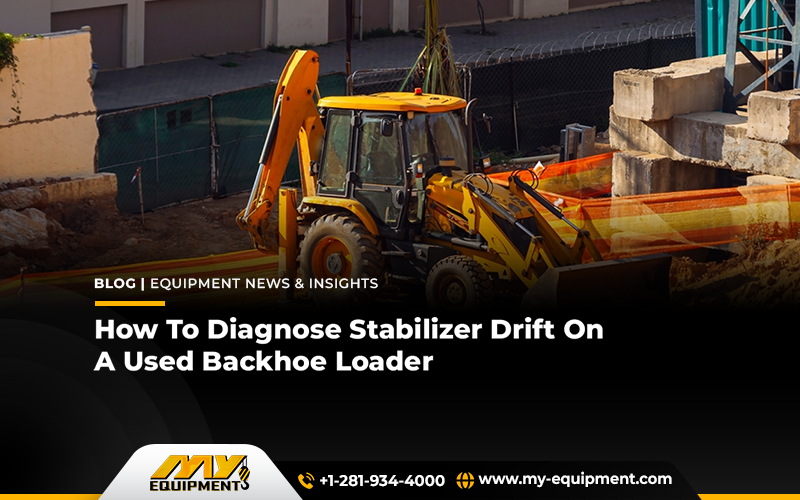
Backhoe loader stabilizers should hold their position once they are lowered and the machine is set to dig. Stabilizer drift is when one or both legs creep away from that position without the operator touching the controls. The movement can be slow and easy to miss during normal operation.
On a used backhoe loader, drift can come from a stabilizer cylinder, a control valve, a hydraulic line or another part of the stabilizer circuit. Finding the cause early reduces the risk of unstable operation and tells a buyer a lot about the condition of the machine. If you are looking at a used backhoe loader for sale, this is a test worth doing before you commit.
Start With A Safe Test
Place the backhoe loader on level ground and operate according to the manufacturer’s instructions for setting the stabilizers. Do not allow anyone to be near the machine and attachment areas during the test. With stabilizers in place, watch to see if either leg starts to move. The machine is holding itself up on hydraulics during this test, so never get under it or between a stabilizer and the frame, and have a qualified technician run any pressure tests.
Give the machine enough time to show any movement. A small change is hard to notice right away, so mark a reference point on the ground or on the stabilizer pad and compare. Check the operator’s manual for any allowable drift. Don’t assume the movement is the same on both sides; compare them.
Check The Hydraulic Cylinders
One of the first parts to check in the event of drift is the stabilizer cylinders. Inspect the cylinder rods and seals for hydraulic oil leaks, damaged surfaces, corrosion, or contamination that may impact the performance of the seals.
Note if the affected stabilizer moves while the other side is stable. If one cylinder is always slipping and the other is not, it could be a problem in that stabilizer circuit. But more testing is required to determine the cylinder as the definite cause.
Examine The Hydraulic Lines
Check hose and fittings on stabilizer cylinders. Check for wet spots, broken hose covers, loose fittings, or hydraulic oil leakage from a fitting.
A hydraulic leak can stop the circuit from holding pressure and let the stabilizer shift. Even a small leak should be fixed, because it tends to grow. Look around the area as well, since hydraulic oil can travel away from the leak point.
Check The Control Valve
If the cylinders and hoses seem to be in good shape, the stabilizer control valve is another area that needs to be checked. A valve may leak internally, causing hydraulic pressure to leak out even if the oil is not leaking from the valve. Understanding how the hydraulic system controls pressure and flow can help narrow down the source of the drift.
Note how the stabilizer behaves when it is released and when it is in use. A technician may need to run hydraulic tests to check whether the valve is letting oil pass internally. On some designs, a holding or check valve at the cylinder keeps the leg in place, so ask the technician to check that too. Don’t replace a valve just because of the symptom, since cylinder and circuit problems can look the same.
Compare Both Stabilizer Legs
Testing both stabilizers will help to determine the issue. If one leg drifts and the other does not, the problem could be in the one cylinder, hose, valve section, or connection. If both legs move in the same direction, it’s likely that something is common to both of them within the stabilizer circuit.
Check whether the speed differs between the legs and whether the behavior changes as the machine warms up. A change with hydraulic oil temperature can point to internal leakage or worn components.
Consider Mechanical Movement
Not all stabilizer movements are hydraulic-related. Check stabilizer leg, pivot points, pins, mounting points, and pads for undue wear or damage. Even if the hydraulic system is operating normally, a worn connection can allow movement to occur. For routine care that helps prevent leaks and wear, see our guide on how to keep your backhoe loader in top condition.
Look for cracks in welds, missing mounting brackets, bent parts, and excessive movement in and around the stabiliser assembly. Mechanical wear may be more significant in a used backhoe loader that has been used for extensive heavy digging or heavy lifting.
Know When To Stop The Test
It is important not to overlook stabilizer drift, as the stabilizers are an important component of the backhoe loader’s support during digging operations. The machine should not be considered ready to work normally until the cause of the inability of a stabilizer to maintain its position has been determined and corrected.
The buyer’s question is whether the cause is a minor leak, an adjustment or a major hydraulic or mechanical repair. A controlled diagnostic test can tell the difference before you buy a used backhoe loader, and it avoids an unexpected repair bill.
Looking for a used backhoe loader for sale? MY Equipment lists used backhoe loaders with specifications, and you can book an inspection and appraisal to have the stabilizers and hydraulics checked before you buy. Browse used backhoe loaders, or ask about an inspection.
FAQs
What causes stabilizer drift on a backhoe loader?
This can be caused by cylinder leakage, valve leakage, damaged hoses, and mechanical wear.
Can a leaking cylinder cause stabilizer drift?
Yes. Leakage inside the cylinder, past the piston seal, or outside it can let the stabilizer lose position.
Can stabilizer drift happen without an external oil leak?
Yes. Internal leakage in a cylinder or valve is not visible from the outside.
Should both stabilizers be tested?
Yes, the comparison of both sides can be used to know if the problem is isolated or if it is a problem in the wider circuit.
Is stabilizer drift serious on a used backhoe loader?
Yes, as uncontrolled stabilizer movement can have an impact on machine stability while operating
Don’t forget to subscribe to our YouTube channel for more equipment offers and insights into the industry.
 1400 Broadfield Blvd, Houston, TX 77084,
USA.

 WhatsApp +1-713-304-6013