
 +1-713-304-6013
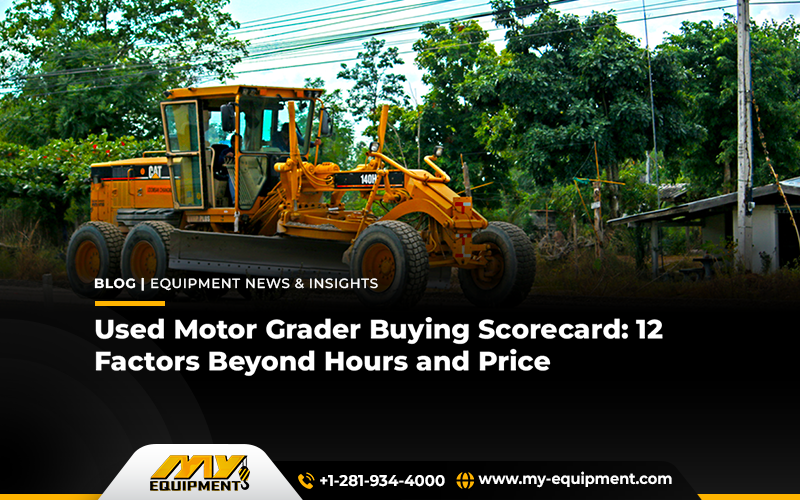
When buying used motor graders, contractors must compare more than asking prices and hours. Machines can differ in suitability, support, repair exposure, and resale. This scorecard helps buyers compare graders against project needs, estimate put-to-work costs, and identify risks before paying. The best choice is the strongest fit, not automatically the cheapest listing.
What Is a Used Motor Grader Buying Scorecard?
A scorecard is a structured way to compare graders against the same buying criteria. Set job requirements, then rate each machine from one to five. Record whether each rating is supported by inspection, invoices, specifications, diagnostics, or seller statements.
What 12 Factors Should You Evaluate Before Buying a Used Motor Grader?
No single factor matters most for every buyer. Compare all 12, but weigh those tied to your contracts, operators, ground conditions, and budget.
1. Application and project suitability
Match the grader to roadwork, shoulders, site preparation, municipal maintenance, or mining. Consider surface, slope, working space, and annual workload; routine-road capability may not suit demanding mine roads.
2. Horsepower, operating weight, and machine capacity
Match power, weight, and blade width to the job. Cat’s 140/140 AWD LVR specifications list 250 hp and 44,613 lb typically equipped; 140 Next Gen specifications list 255 hp and 42,543 lb. Verify exact configuration and year.
3. Expected grading productivity
Estimate output using material, finish, pass count, travel distance, blade width, and operator skill.
4. Drive configuration and traction requirements
Choose a standard drive or AWD for the terrain. AWD can help where traction is essential, but compare its price and maintenance exposure with the work it will actually perform.
5. Attachment package and machine completeness
List the required scarifier, ripper, front blade, snow equipment, and auxiliary hydraulics. Confirm fitment; price missing attachments, installation, and transport. A missing attachment or a technology upgrade bill can quickly erase a cheaper used construction equipment price advantage.
6. Grade-control and technology readiness
Check displays, receivers, sensors, wiring, calibration, software, and licenses. “GPS-ready” may mean prewired, not operational. John Deere details SmartGrade integration and compatibility, including license-transfer conditions between like machines. Confirm the exact setup in writing.
7. Operator and existing fleet compatibility
Check controls, visibility, operator familiarity, and training needs. Confirm the grader’s attachments, data, and maintenance processes fit your current fleet.
8. Maintenance and repair documentation
Request service records, invoices, oil analyses, and rebuild details. Match dates, hours, and serial numbers. An undocumented rebuild deserves less confidence than traceable repairs.
9. Remaining productive component life
Ask an independent inspector to assess the engine, transmission, tandems, circle, drawbar, articulation, and hydraulics. Price likely repairs within your ownership period using written estimates.
10. Parts availability and service support
Verify parts, technicians, manuals, and diagnostics for the exact generation. Caterpillar offers motor grader owner manuals and repair resources; confirm specific availability with the dealer.
11. Delivered-ready acquisition cost
Add purchase price, repairs, attachments, technology work, transport, taxes, fees and initial service. For buying used motor graders, delivered-ready cost beats asking price; use identical categories for each candidate.
12. Financing suitability and future resale potential
Match payments to expected utilization and contract cash flow. Estimate resale from local comparables, model demand, configuration, and records, but treat proceeds as uncertain.
How Should You Weight and Score Each Buying Factor?
Not every factor matters equally to every buyer, so use this simple four-step method to turn the 12 factors into one score out of 100.
Step 1: Set your weights
Group the 12 factors into five categories and give each one a weight. The weights below are a starting point, not an industry rule. Adjust them to fit your contracts, operators, and budget.
| Category | Weight | Factors Included |
| Job fit and capacity | 30% | Factors 1 to 7 |
| Condition and documentation | 25% | Factors 8 and 9 |
| Parts and service | 15% | Factor 10 |
| Acquisition and financing | 20% | Factor 11 and the financing part of Factor 12 |
| Resale | 10% | The resale part of Factor 12 |
Step 2: Rate each factor from 1 to 5
Give every factor a rating from 1 (poor) to 5 (excellent). Then average the ratings inside each category to get one rating per category.
Step 3: Calculate your score
For each category, use this formula:
Weighted points = Category weight × Category rating ÷ 5
For example, if a grader’s “Job fit and capacity” rating averages 4 out of 5, the points are 30 × 4 ÷ 5 = 24 points. Do this for all five categories, then add the results together. The total is your score out of 100.
Step 4: Check how reliable your evidence is
Mark each rating as verified (backed by inspection or invoices), partial, or seller-stated. A high score built on weak evidence is still a risky buy.
How Do You Calculate the Actual Cost of a Used Motor Grader?
Use identical ownership periods and workloads. Delivered-ready cost is purchase price plus repairs, attachments, technology work, transport, taxes, fees and initial servicing.
Calculate cost per productive hour by subtracting expected resale from total ownership and operating costs, then dividing by realistic productive hours. Include fuel, maintenance, repairs, insurance and financing interest or fees; do not double-count loan principal and purchase price. Apply identical assumptions to every machine you compare.
When Should You Reject a Used Motor Grader Regardless of Its Score?
Pause or reject a deal for unresolved ownership, serial number, or lien concerns; major structural or safety defects; unpriced steering or drivetrain problems; or failure to meet project or regulatory requirements. Unverified essential technology is another deal-breaker. Strong scores cannot offset a critical failure.
How Does the Scorecard Help You Choose Between Two Used Motor Graders?
Imagine Grader A costs less but needs attachments and technology upgrades. Grader B costs more, includes the required package and has traceable repairs. Score both for the same job, verify evidence, then compare delivered-ready and productive-hour costs. B wins only if its added capability and lower expected exposure justify the premium. This shows how to buy a used grader without letting the asking price decide.
Bottom Line: Prioritize long-term value over upfront purchase price.
Choosing the right used motor grader requires more than comparing asking prices and operating hours; buyers must evaluate suitability, condition, productivity, and long-term ownership costs.
A structured buying scorecard helps contractors compare shortlisted machines, identify hidden risks, and understand which option offers better value for their operations. Ultimately, the best investment is the grader that meets project requirements, minimizes ownership risks, and delivers dependable performance within budget.
Looking for a used motor grader? Browse our inventory of quality graders from top brands, or contact our team for specifications, availability, and financing.
Frequently Asked Questions
Is a lower-hour used motor grader always a better investment?
No. Application, service history, component condition, and remaining life matter alongside the meter. Compare records and inspection findings, not hours alone or assumptions.
How do you compare two used motor graders with different specifications?
Start with project capacity, then compare configuration, attachments, condition, support, and realistic productivity on equal cost assumptions.
What is a good score when buying a used motor grader?
No universal passing score exists. Set minimum requirements, verify evidence, and reject deal-breakers. Use scores to rank suitable machines, not replace inspection.
Don’t forget to subscribe to our YouTube channel for more equipment offers and insights into the industry.
 1400 Broadfield Blvd, Houston, TX 77084,
USA.

 WhatsApp +1-713-304-6013