
 +1-713-304-6013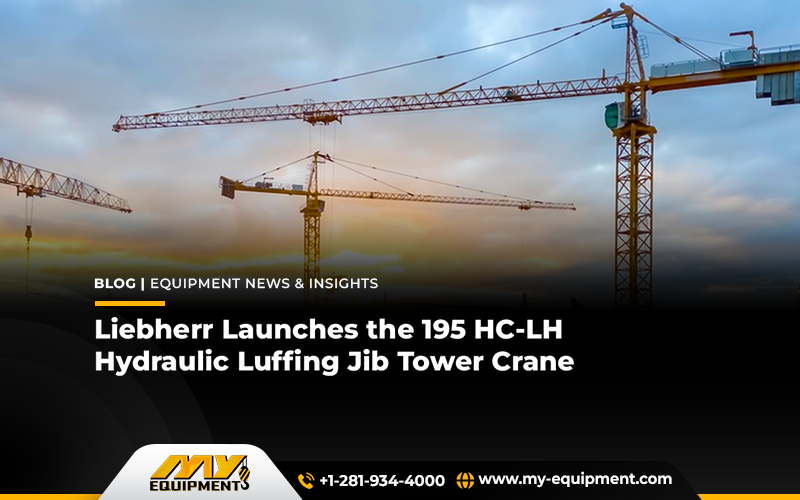
Cranes are under particular pressure due to urban building. Raw lifting capacity only gets you so far when you are lifting between existing structures, over traffic, and within meters of nearby houses. Just as important are precise placement, quick repositioning, and a compact workspace. Liebherr created the 195 HC-LH to address this issue.
The 195 HC-LH, a hydraulic luffing jib tower crane is made especially for compact urban areas, It was introduced in the first week of March 2026. It has a minimum radius of only three meters and completes a full luff cycle in less than ninety seconds. Those figures speak for themselves for anyone who has spent time navigating the limitation of traditional luffing cranes in crowded urban settings. Let’s review this crane now.
What Sets It Apart
The majority of luffing cranes use cable systems to regulate their jib angle. Instead of using cable systems, the 195 HC-LH uses a specialized hydraulic power unit in conjunction with a cylinder combination to provide smoother, more controlled movement. In addition to cutting down on lift delays, this sub-90-second luff time also, and perhaps more significantly, shortens the amount of time a load must pass over pedestrians or vehicles. That is a real operational advantage on city center sites where neighbor relations and permissions are part of the daily routine.
Additionally, Liebherr included sensor-based controls to ensure precise positioning in windy environments. It’s simple to ignore in a specification sheet, but when you are working on a surface on a windy day with a little exclusion zone, it becomes very real.
Technical Specifications: Liebherr 195 HC-LH
| Specification | Details |
|---|---|
| Tower System | Narrow design with modular configurations |
| Module Compatibility | Compatible with 16 EC modules |
| Transport & Installation | Straightforward process |
| Peak Lifting Capacity | ~12,000 kg (near tower) |
| Tip Load | ~2.55 tonnes at 55 meters |
| Luffing Stabilization | Onboard motors with computer-assisted controls |
| Configuration Options | Supports varying heights and compact site footprints |
Where It Fits in the Market
There is competition in the urban luffing market. Manitowoc has prioritized transport flexibility and operator ergonomics. Comansa and Favelle-Favco compete on raw capacity and tip reach. Liebherr takes a distinct strategy, focusing on hydraulic precision, a minimal out-of-work footprint, and site behavior that facilitates neighbor management and permitting.
Contractors and rental firms that frequently deal with permission friction and site disturbance on inner-city projects are the subject of this intentional decision.
Practical Impact On Contractors and Rental Fleets
Faster repositioning between lifts, fewer road closures, and smaller exclusion zones are the true benefits for contractors. This combo can save days on a complicated metropolitan lifting routine.
The main advantages for rental organizations are speedy installation and flexible configuration. However, before the figures make sense, operator training, shipping dimensions, and foundation requirements must be taken into consideration in project cost estimations.
Utilization is what determines whether to buy or rent. Ownership is probably justified by long-term inner-city work. Renting is preferred in occasional urban constructions. In any case, footprint benefits, cycle-time data, and permit-ready documentation are what city-focused purchasers want to see, thus rental businesses presenting cranes for sale in urban markets should be at the forefront.
Site Readiness Checklist
Work through these fundamentals before to implementing the 195 HC-LH:
- Check the criteria for neighbor notifications and pedestrian clearance strategies.
- Create transportation lanes free of cranes.
- Co-ordinate with any train or metro authorities within 100 meters.
- Run wind and hoist-path simulations
- Examine the utilities located beneath the load routes.
- Perform a thorough hydraulic pre-inspection that includes hoses, valves, and leak testing.
Commissioning reports and permit-ready drawings, particularly those that demonstrate the minimum out-of-work envelope, accelerate municipal approvals and prevent expensive stoppages.
Training and Operator Readiness
Liebherr is supporting the launch with training modules and hands-on experience. Given increased regulatory scrutiny following recent urban site events, planning is more important than ever. Before the first lift, operators should have completed site-specific training, logged simulator hours, and had a written maintenance plan approved.
Fleet managers should get vendor-led commissioning support ahead of time, whether they are buying or renting. Cranes for sale ads that include commissioning assistance and verified training support will get credibility with selective purchasers and approval agencies.
Early Deployments And What To Watch Next
Demo units have already been tried on front lifts and tight buildings, where their precise placement and small footprint made them ideal for finishing and external work. Fleet trials are being conducted by rental businesses, and CONEXPO and dealer locations are displaying full commercial availability.
Cycle-time data from early installations and CONEXPO demo reports will provide the most realistic image for anyone monitoring real-world performance. In urban markets where purchasers must speed up the permission and approval process, cranes for sale listings from MY-Equipment accompanied by complete specification sheets and deployment checklists will work best.
 1400 Broadfield Blvd, Houston, TX 77084,
USA.
1400 Broadfield Blvd, Houston, TX 77084,
USA.
 WhatsApp +1-713-304-6013