
 +1-713-304-6013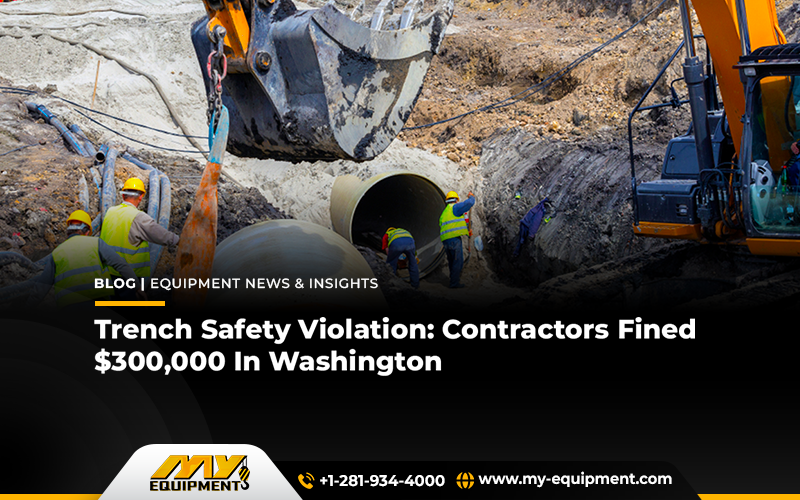
When using heavy machinery in the construction industry, it becomes essential to prioritize safety. In actuality, safety frequently turns into a life-or-death duty rather than merely a legal necessity.
Due to trench safety violations, a recent tragic incident in Washington resulted in a hefty fine. Contractors were fined because, in spite of all the options, it is their primary duty to ensure that safety regulations are followed at the job sites.
According to the incident’s investigation, two contractors were fined $300,000 after workers suffered serious injuries due to fall and trench hazards.
This case is sufficient to force equipment operators, contractors, and project managers to prioritize jobsite safety.
What was actually discovered after the investigation in Spokane?
The Washington State Department of Labor & Industries reports that inspectors discovered severe trench hazards as soon as they arrived at the location in early July 2025.
Without cave-in protection or a safe way out of the trench, workers were working between a nearly vertical dirt wall that was more than 22 feet high and concrete foundation forms that rose about 10 feet.
This arrangement is particularly risky when working in an excavation. Without adequate shoring, shielding, or sloping, workers have little chance of escape when soil collapses unexpectedly.
Additionally, inspectors saw workers constructing foundation walls and cement footings while at risk of impalement from unguarded vertical steel rebar that protruded from concrete footings.
These were the major violations that were actually captured by the neighborhood as well. It was a helpful resource in the entire investigation.
Why Trench safety enforcement is a must
It should not be difficult to understand the importance of trench safety. Excavation and trenching are 2 of the riskiest construction jobs, which can be deadly in a matter of minutes.
Because the risks are well-documented and avoidable with appropriate planning, safeguards, and oversight, regulatory bodies take these infractions seriously.
In order to keep workers safe, safety officials stressed that stop-work orders are still in place at the site. Officials stated clearly that the conditions captured in photos demonstrated how hazardous the workplace had become.
What should be learned by contractors and equipment operators?
This case will be observed by contractors nationwide. Not only can safety violations result in paperwork and fines, but they can also cause long-term reputational damage, project delays, and, most importantly, endanger employee lives.
Particularly when working at depth or close to vertical walls, proper excavation design, professional supervision, and equipment use are essential.
Before the heavy equipment machinery even touches the ground, contractors using it for trenching, foundation work, or site preparation must comply.
Crew safety and project advancement depend on soil analysis, engineered plans, protective systems, and ongoing supervision.
 1400 Broadfield Blvd, Houston, TX 77084,
USA.
1400 Broadfield Blvd, Houston, TX 77084,
USA.
 WhatsApp +1-713-304-6013