
 +1-713-304-6013
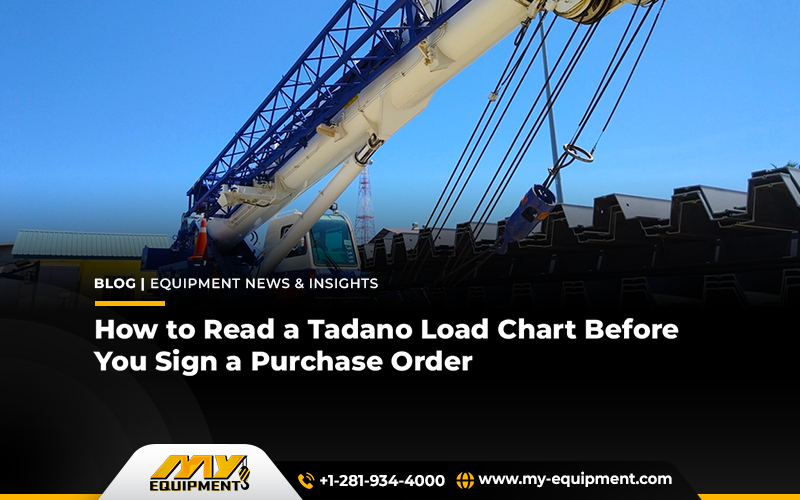
A crane’s advertised tonnage tells you its size class, not what it can lift on your job. If you are comparing Tadano cranes for sale, learn how to read the load chart for the specific machine, configuration, boom length, and working radius you plan to use before you sign a purchase order. A crane rated at 50 tons will not lift 50 tons at every reach. The chart shows what the machine can actually handle and whether it fits your current work.
What Information Do You Need Before Reading the Chart?
Gather these details first:
– Exact model and serial number
– Machine configuration
– Planned load weight
– Load radius
– Required lift height
– Boom length
– Working area
– Outrigger position
– Counterweight and jib configuration
– Parts of line (line segments)
– Hook block and rigging weights
Tadano’s product guide says the rated lifting capacity is read from conditions such as outrigger extension width, working area, boom length, jib length, jib offset angle, and load radius. Without these details, buyers end up comparing two Tadano cranes on headline tonnage even when their usable capacity is quite different.
Check the units as well. Many U.S. charts use US tons, and 100 US tons is about 90.7 metric tonnes.
How to Read the Main Parts of a Tadano Load Chart
Find the Boom Length
Start with the boom length for your lift. Charts list several boom lengths and extension conditions. A longer boom does not mean more capacity. Capacity usually falls as the boom reaches farther.
Find the Load Radius
The load radius is the horizontal distance from the crane’s center of rotation to the load. It is one of the most important figures on the chart, so measure it for your actual setup instead of estimating. Tadano’s charts use the actual load radius, which includes boom deflection. The chart shows lifting conditions, not a fixed measurement.
Match Boom Length and Radius
Find where your boom length and radius meet in the table. That number is the rated capacity for that setup. If your boom length or radius falls between listed values, use the next longer boom length or radius, which has the lower capacity. For example, if a lift needs a 40-foot radius and the chart lists 35 and 45 feet, read the 45-foot value. Never take the larger number because it is closer to your estimate.
Check the Working Area
Next, decide where the load will be swung. Stability changes with the direction of the lift, so Tadano charts can list different capacities by working area. For example, capacity on outriggers over 360 degrees is not the same as capacity free on wheels. The value for one area may not apply to another. This matters for rough terrain cranes working next to buildings, trenches, or slopes, or where access is limited.
Read the Chart’s Footnotes
The footnotes are part of the chart. They can state the required outrigger deployment, counterweight, ground or tire conditions, jib arrangement, parts of line and other limits. They also say whether the hook block, slings, and other lifting devices are already included in the rated capacity or must be added to the weight of the load. This differs between Tadano models, so read the notes for your exact machine.
That means the chart number is not always the weight you can put on the hook. Before you buy a Tadano crane, ask the seller for the correct load chart, the operating manual and the configuration details. If the documents don’t match the machine in the ad, stop and confirm the difference.
Outriggers: The Setup That Can Change Your Buying Decision
Outriggers affect stability, so they can change available capacity a lot. Tadano’s guidance ties capacity to outrigger extension width. Tadano’s Smart Chart system, found on models such as the GR-1000XL-3, adjusts lifting performance to the outrigger configuration. Newer models such as the GR-1000XL-4 also have Smart Counterweight, which allows two counterweight positions to increase lifting capacity.
Ask what outrigger setup your sites can actually accommodate. A machine can look ideal on paper and be less useful if your sites can’t use the setup behind its strongest chart.
The 2020 Tadano GR-1000XL-3 is a good example. It is a 100 US ton rough terrain crane, and its performance depends on configuration. Read our guide to the 2020 Tadano GR-1000XL-3 for its key features.
Calculate the Real Capacity Before Signing the PO
The safest approach is to compare the exact lift you need with the matching chart entry. Here is an example with made-up numbers:
– Planned load: 18 tons
– Radius: 40 feet
– Boom: 60 feet
– Outriggers: fully extended
– Jib: none
– Chart capacity: 22 tons
– Hook block and rigging: 1.5 tons (check the chart notes to see whether this is already deducted)
Subtract the hook block and rigging from the chart capacity: 22 minus 1.5 leaves 20.5 tons of usable capacity. The 18-ton load fits, with 2.5 tons to spare. Together, the load, hook block and rigging weigh 19.5 tons, which is about 89% of the chart capacity. Many safety programs treat a lift above 75% of rated capacity as a critical lift that needs a written lift plan. Definitions vary by company and site, so follow the rule that applies to your project. For more on lift planning, see our guide on whether a project needs a standard or heavy-lift crane.
This check shows whether a Tadano crane suits your work or only looks good on its advertised capacity. It can also show when a different machine or configuration would be a better fit.
5 Load-Chart Red Flags Before Buying a Used Tadano
- The seller promises a maximum tonnage but can’t provide the load chart.
- The chart doesn’t clearly match the model and configuration.
- The counterweight or outrigger setup the chart needs isn’t available.
- Capacity drops sharply close to the radius you need.
- The chart’s notes, deductions and limits are unclear.
A reliable seller shares the documents that come with the machine. Treat missing capacity information as a due diligence problem, not paperwork you can fix later.
Final Pre-Purchase Load Chart Checklist
Before you sign, confirm these:
– The chart matches the model and serial number
– The radius you need
– The boom length
– The working area
– The outrigger setup
– The jib and counterweight configuration
– Deductions for the hook block and rigging
– Parts of line
– Your expected load
Keep a record of the approved configuration with the purchase documents.
Conclusion: Capacity Matters More Than Tonnage
Headline tonnage tells you what kind of machine a crane is. The load chart tells you whether it can do your actual lift. Study the chart before you issue the purchase order, not after delivery. Do that, and you can choose a Tadano that earns its place in your fleet, avoid expensive capacity surprises, and buy for the work you really have.
Get the Load Chart Before You Buy
Looking for Tadano cranes for sale? MY Equipment lists used cranes with specifications, and you can book an inspection and appraisal before you buy. Browse used cranes for sale, or ask about an inspection and appraisal.
Frequently Asked Questions
What is a crane load chart?
It is a table of the rated lifting capacities for a specific crane at each boom length, load radius, and configuration, with notes on outriggers, counterweight, and other conditions.
Does a 100-ton crane lift 100 tons at any reach?
No. Maximum capacity is available only at a short radius and in the best configuration. Capacity falls as the load moves farther from the crane.
Are the hook block and rigging included in the rated capacity?
It depends on the model. Some Tadano charts say the hook block and slings must be added to the load, while others include some of them in the rating. Read the notes for your exact machine.
What if my radius or boom length falls between two chart values?
Use the next longer boom length or radius. It has the lower capacity and keeps you on the safe side.
Should I ask for the load chart before buying a used Tadano crane?
Yes. Ask for the chart, the operating manual, and the configuration details for the exact serial number, and confirm they match the machine.
Don’t forget to subscribe to our YouTube channel for more equipment offers and insights into the industry.
 1400 Broadfield Blvd, Houston, TX 77084,
USA.

 WhatsApp +1-713-304-6013