
 +1-713-304-6013
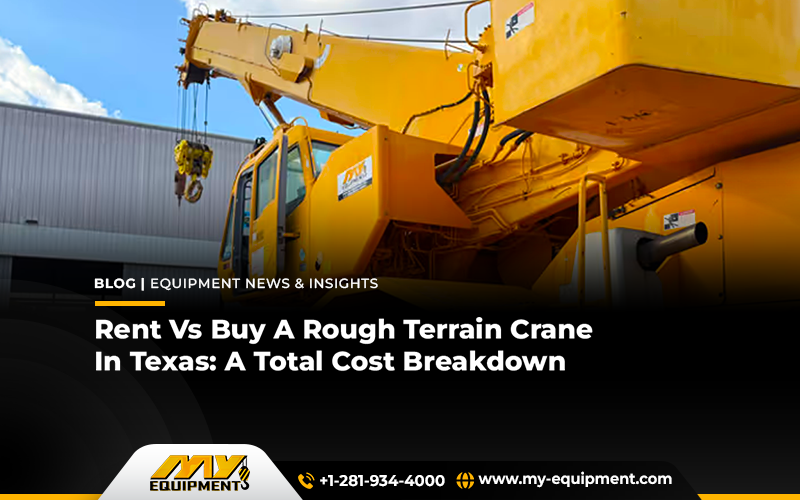
Texas is one of the busiest crane markets in the U.S. Demand for rough terrain cranes remains strong because of petrochemical projects along the Gulf Coast, industrial growth in Houston, commercial construction in Dallas-Fort Worth, and infrastructure work across the state. For contractors, the decision to rent or buy a crane often depends on how often they expect to use it. They should consider annual working hours, required lifting capacity, local rental rates, and the full cost of ownership, including maintenance, insurance, transportation, and storage.
This article will look at that calculation in detail. It discusses the cost of owning a crane in Texas, including acquisition, insurance, maintenance, and storage, and the rental rates at 80 ton and 100-ton classes. It also deals with the concept of bare crane rental for contractors who provide their own operators and when each option is truly more cost-effective.
The Texas Crane Market: Why This Decision Is Harder Here
Texas is different from the national average when it comes to crane utilization. The Gulf Coast industrial market around Houston, Beaumont, and Corpus Christi (refineries, chemical plants, LNG plants, etc.) creates crane demand over an extended period of time instead of short project cycles. A turnaround at a large refinery can run six to twelve weeks, sometimes six or seven days a week, and may need heavy crane support. That pattern favors ownership. The same contractor that secures a big industrial contract, however, could find itself with months between contracts where an owned crane is a money-losing proposition.
Commercial and infrastructure markets in Dallas-Fort Worth, San Antonio, and Austin are different; they’re typically smaller projects, have a wider range of capacity needs, and have less consistent crane-intensive scopes. In these markets, renting the proper crane for every project has more justification. In some cases, particularly in the non-major metros, rentals may be unavailable at certain capacities, mobilization costs may be high enough to change the economics of renting, and lead time can be longer.
What Rough Terrain Crane Ownership Actually Costs
Ownership costs for an 80-100 ton rough terrain crane can be divided into several components, and although the purchase cost is the biggest single item, it is not the only major cost over the ownership period.
The new Tadano GR800XL for sale has a list price of between USD 1.2 million and USD 1.5 million. The Tadano GR1000XL for sale is priced at about USD 1.5 million to USD 1.9 million. With the current commercial financing rate, a USD 1.4 million investment spread out over 60 months and at 7.5 percent interest comes to about USD 28,000 per month. The interest for the term of the loan increases the total cost by about USD 283,000.
Annual Ownership Cost Summary (80-Ton Class, Financed New):
| Cost Category | Annual Estimate |
| Loan payments (60-month, 7.5%) | ~USD 336,000 |
| Insurance | ~USD 25,000 |
| Storage / yard | ~USD 24,000 |
| Scheduled maintenance | ~USD 18,000 |
| Inspection and certification | ~USD 8,000 |
| Miscellaneous (tires, fluids, wear items) | ~USD 12,000 |
| Total Annual Ownership Cost | ~USD 423,000 |
If the cost is this high, the crane has to earn enough billable revenue to cover the cost of owning it, and the only way to know that is a good estimate of how many days per year it will be in use.
Crane Rental Rates In Texas
The cost of a rough terrain crane hire in Texas will depend on the capacity of the crane, the length of time it is needed, and the type of rental (bare or operated). The figures below are the current market rates for the Houston area.
80-Ton Rough Terrain Crane (Bare Rental):
- Daily: USD 2,500 – USD 3,500
- Weekly: USD 9,000 – USD 13,000
- Monthly: USD 28,000 – USD 38,000
100-Ton Rough Terrain Crane (Bare Rental):
- Daily: USD 3,200 – USD 4,500
- Weekly: USD 12,000 – USD 17,000
- Monthly: USD 36,000 – USD 48,000
These rates are for the crane only; fuel, operator, transport, and rigging are extra. The cost of moving inside the Houston metro area is between USD 1,500 and USD 4,000. Moving to West Texas or rural South Texas can cost USD 8,000 to USD 15,000 per way. Operated rental (crane plus a rental company-supplied operator) is an additional USD 750 to USD 1,200 per day, which puts an 80-ton day rate at roughly USD 3,250 to USD 4,700, and at USD 4,500 to USD 6,500 on union-rate industrial sites on the Gulf Coast.
Bare Crane Rental Vs. Operated Rental
The most common form of crane hire is for contractors to hire the crane with their own certified operators. It is more economical since the operator’s labor cost is already included in the contractor’s overhead and not charged at the rental market rates.
The best scenario for bare rental is when the contractor has an operator who can work full-time, the duration of the project is long enough for a month rate, and the operator is currently NCCCO certified. Operated rental is more appropriate if the contractor does not have a certified operator, the job is short enough that a day or week rate is applicable, or the site is union classified, but the contractor does not have the union classification internally.
The main thing to remember for the rent vs. buy decision: If the contractor owns a crane, he will still require an operator. Under both ownership and rental, there is an operator cost.
80-Ton Vs. 100-Ton: How Capacity Affects The Math
The capacity question is closely related to the rent or buy question. If a contractor has a regular requirement of 80 tons but sometimes requires 100 tons, he will have a different calculation than a contractor who requires 100 tons regularly.
An owned 80-ton crane plus a rented 100-ton crane may be a cost-effective hybrid. The owned 80-ton covers most of the work and is the most cost-effective per hour, and the rental machine is filling in the space where there needs to be more machines, but not so much that it would be owned. The reverse (owning a 100-ton and renting an 80-ton) is seldom required, as 80 ton lifts are within a 100 ton crane’s rated chart. When lift plans are designed properly, the majority of lifts that occur in the construction industry, both general commercial and Gulf Coast industrial, are within an 80 ton rated capacity. Typically, lifts that need a 100-ton machine are not based on the amount of weight to be lifted, but on the distance of the radius.
The Breakeven Calculation: When Buying Starts To Win
The annual ownership cost of an equivalent 80-ton unit is about USD 423,000 for a new unit financed, and the monthly bare rental rate is USD 33,000 for equivalent capacity:
- 12 months of rental: USD 396,000
- Roughly equal to annual ownership cost: USD 429,000 (13 months’ rent)
This comparison is not complete, though. Whether the crane is working or not, there are costs associated with ownership. The cost of renting the crane is incurred only when the crane is used. A more accurate model corrects for the actual number of billable days:
- If they own them for 200 billable days per year, the cost of ownership per revenue day is ~USD 2,115.
- The average ownership cost per revenue day is ~USD 2,820 at 150 billable days per year.
- An owned crane billing $3,000 per day for 200 days earns $600,000 in revenue. After the $423,000 annual ownership cost, about $177,000 remains before operator wages, fuel, and transport.
For a new 80-ton unit financed, the breakeven is around 140-150 revenue days per year at a USD 3,000 day rate. Above that, ownership is the better value. Below that, it’s the rental option that’s the cheaper one.
Used Rough Terrain Cranes: How They Change The Equation
The total cost of owning a rough terrain crane goes beyond its purchase price. Contractors also need to consider maintenance, insurance, transportation, inspections, storage, and other operating expenses. For example, current MY Eipment listings show a 2008 Tadano GR-800XL-1 with 2,495 hours at around $160,000, while a 2020 Tadano GR-1000XL-3 with about 2,930 hours is listed at around $750,000. These price differences show why contractors should compare the full cost of ownership with expected equipment utilization before deciding whether buying a crane makes financial sense.
A used crane makes the cost of financing significantly lower at these rates. Financing a newer used 80-ton crane at around $650,000 over 48 months at 7.5 percent annual interest comes to about $15,700 per month, roughly 44 percent less than the new machine’s payment. With a well-maintained used unit, the total annual ownership cost is about USD 240,000 to USD 280,000, which means the breakeven point is more likely to be reached by most active Texas contractors, at about 80 to 90 revenue days per year.
Technical Specifications: Tadano GR800XL And GR1000XL
| Specification | Tadano GR800XL | Tadano GR1000XL |
| Rated Capacity | 80 US tons | 100 US tons |
| Main Boom Length | 39.4 ft – 154.2 ft | 39.4 ft – 154.2 ft |
| Engine | Cummins B6.7, Tier 4F | Cummins B6.7, Tier 4F |
| Engine Output | ~280 hp | ~280 hp |
| Carrier Drive | 4x4x4 | 4x4x4 |
| Transport Width | 10 ft 10.5 in | 10 ft 10.5 in |
| Transport Weight | ~99,800 lb | ~117,220 lb |
| Counterweight | 14,330 lb | 19,840 lb |
| Outrigger Span (max) | 23 ft 7 in | 25 ft 11 in |
- Key Highlights:
The models both feature the widely supported Tier 4 Final Cummins B6.7, which has parts availability throughout Texas, including outside the Houston area. - The 4x4x4 carrier delivers the real-world all-terrain mobility that is often required on project sites in the soft ground and muddy conditions found in the Gulf Coast and rural Texas areas.
- The capacity is monitored in real time by Tadano’s AML-E load moment indicator, and functions are automatically disabled before the rated load limit is reached, which is a critical safety and compliance feature.
- Both models carry a 154.2 ft main boom, which gives long reach on high industrial structures and bridge work without the need for lattice extensions.
Permits, Insurance, And Compliance Costs In Texas
Both the Tadano GR800XL and GR1000XL are over the Texas oversize/overweight limits. Each road move requires a TxDMV oversize/overweight permit plus escort vehicles (USD 300 to USD 800 per road move). Self-propelled cranes are permitted on a mileage basis, with the fee set by size and weight. If the crane is to be moved by contractors regularly, they should expect to pay USD 5,000 to USD 15,000 per year for transport compliance costs.
OSHA 29 CFR 1926 Subpart CC requires a crane inspection every year by a qualified person, which is about USD 3,000 – USD 6,000 per crane. The cost of insurance for an 80- to 100-ton RT crane in Texas is USD 18,000 to USD 35,000 per year for physical damage, lifting liability, and rigger’s liability. This cost is a fixed cost that is not dependent on use and should be part of any fair method of cost of ownership.
Maintenance, Wear, And Hidden Ownership Costs
For Tadano’s GR-series cranes, which operate 150 to 200 hours a month, maintenance costs of around USD 15,000 to USD 25,000 per year are expected. The most important consumable is wire rope, with main and auxiliary hoist ropes ranging from USD 2,500 to USD 5,000 per set and potentially being replaced annually on heavily used machines according to OSHA criteria. The cost of boom wear pad replacement on a 5-section boom is between USD 1,500 and USD 4,000 for parts and labor.
The cost of unplanned downtime is the most unpredictable. Damage to the boom, a boom section failure, or a major hydraulic failure can take a crane out of service for 2 to 6 weeks and cost USD 30,000 to USD 120,000. The contractor incurs a loss of revenue, incurs replacement costs if he/she rents a replacement at market rate or both, and continues to incur ownership costs during that period.
Buying Guide: New Vs. Used RT Crane In Texas
When a Texas Tadano dealer sells a new crane, the machine comes with a full factory warranty, a predictable maintenance schedule, and the latest dealer support. When a contractor expects to use the machine for 10 to 15 years and has a high usage rate, a new purchase removes uncertainty about repairs in the machine’s early life. The factory warranty for Tadano RT cranes usually comes with 12 months or a 2,000-hour warranty for major components.
Used cranes are available in the Texas market. Before buying, the following points need to be considered:
- Inspection of the full boom, including section extensions, wear pads, sheaves, and boom nose condition.
- Condition and remaining service life of all wire ropes
- Measurement of backlash and wear on the slewing ring.
- The integrity and extension geometry of outrigger cylinder seals.
- Oil samples for contamination and wear metals, engine and hydraulic oil.
- The calibration verification of the load moment indicator of the AML.
Full service history record (preferably from Tadano dealer)
The riskiest purchase is an auction unit that has not been inspected beforehand. The safest acquisition method is from a known contractor with a service history.
Operator Training And Certification
OSHA 29 CFR 1926 Subpart CC requires crane operators on construction sites to be certified by an accredited testing organization, licensed by a qualifying government entity, or qualified through an audited employer program. The NCCCO RT Crane certification is the most widely accepted route for rough terrain crane operators in Texas.
The certification is a combination of a written exam and an RT crane practical exam, and is renewed every five years. In the Gulf Coast petrochemical industry, operators are usually required to have OSHA 10 or OSHA 30 cards and the necessary site safety certification from the client as part of their requirements to be able to access an industrial site.
A contractor who rents a crane without an operator cannot put it to work until the operator has received his/her NCCCO RT certification. If the contractor owns the cranes, keeping the operator certification currency of the workforce is a continuous administrative task, and the amount of site qualification paperwork, continuing education requirements, and dates to keep up with is an overhead that can be easily overlooked when considering crane ownership.
If you are looking for well-maintained and inspected Tadano cranes for sale, then visit MY Equipment, we provide all kinds of high-performing and well maitained used heavy equipment in one place. Visit our website now and check our latest inventory.
FAQs
1: Is buying a used rough terrain crane cheaper than buying new?
Financing a used 80-ton crane at around USD 650,000 over 48 months comes to about USD 15,700 per month, roughly 44 percent less than the new machine’s payment.
2: When is bare crane rental the best option?
Crane delivered without an operator – best for contractors already using a certified NCCCO RT operator on payroll.
3: What is the cost to mobilize within Texas?
USD 1,500-4,000 in the Houston metro area, USD 8,000-15,000 each way for long-distance moves to West or South Texas.
4: Do the Tadano GR800XL or Tadano GR1000XL make a good used purchase?
Yes, if it is bought with a professional third-party inspection and a documented service history (contingency budget USD 30,000-60,000 per year for the first 2 years).
5: Outside of OSHA requirements, do Texas contractors require a state crane operator license?
OSHA requires crane operators to be certified or qualified, and NCCCO is the most widely accepted certification. Texas has no separate state crane operator license, but many industrial clients require NCCCO on site.
 1400 Broadfield Blvd, Houston, TX 77084,
USA.

 WhatsApp +1-713-304-6013