
 +1-713-304-6013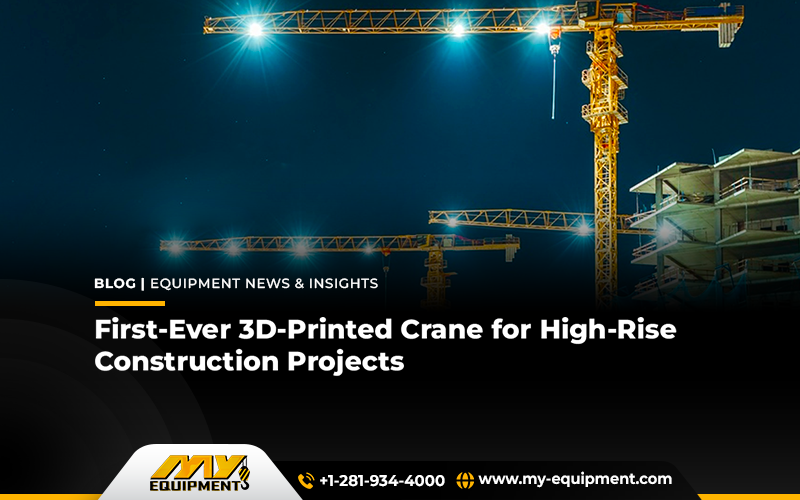
The development of the first 3D-printed crane for high-rise construction projects marks an important milestone in the construction industry. At a time when contractors are faced with labor shortages, rising material costs, project delays, and growing pressure to improve productivity, this innovation offers a new approach to erecting larger structures more effectively.
Unlike typical construction 3D printers, which have height and reach limitations, this tower crane-based system combines crane flexibility with automated concrete printing technology. It demonstrates to developers, contractors, and equipment investors how future structures might be built faster, safer, and with greater precision. Let us discuss in depth.
What is 3D-Printed Crane
A tower crane-based 3D construction printer combines a traditional tower crane design with robotic concrete printing capabilities. Unlike standard tower cranes, which can only hoist cargo, this machine can print structural components on-site. It also differs from gantry-based 3D printers, which have a fixed frame and often struggle with large-scale vertical construction.
The technique was created by Luyten, an Australian construction technology business. The ASCEND A27 platform incorporates current robotics, automation, and concrete printing into a tower crane arrangement. The news made international headlines because it solves one of the most difficult challenges in construction automation: building upward rather than outward.
It is regarded as a world first since it combines tower crane reach with 3D concrete printing capabilities. The technology is intended to create buildings up to 100 meters tall, converting a crane from a material-handling machine to a robotic construction platform capable of producing structural components on-site.
How Does a 3D-Printed Crane Work?
Core Components
The system includes:
- Tower Crane Construction
- AI-powered control software for a robotic printing head.
- an automated mechanism for delivering concrete.
When combined, these elements allow for accurate production with little operator involvement.
Detailed Construction Process
- A digital building model is the first step in the process.
- The design is transformed into printable instructions using construction planning software.
- As anticipated, the concrete is then deposited layer by layer by the crane.
- Quality is continuously monitored by sensors, which enable necessary modifications.
- Once printed components are finished, they are put together with additional structural elements and reinforcement.
Role of AI and Automation
Optimizing printing pathways, improving accuracy, and decreasing errors all depend on artificial intelligence. The technology can react to shifting site conditions thanks to real-time monitoring, which helps contractors maintain uniformity and quality throughout the project.
Why Traditional High-Rise Construction Needed This Innovation
Current Industry Challenges
There are a number of ongoing issues with high-rise buildings. Major global marketplaces are still impacted by the lack of skilled workers. Over the previous ten years, construction expenses have increased significantly, and schedule overruns are still frequent. Project complexity is further increased by material waste and worker safety hazards at heights.
Limitations of Existing Construction 3D Printers
A lot of current 3D construction printers have limited printing regions and height restrictions. As projects expand, they frequently need to be relocated, which lowers efficiency. Another significant issue has been its scalability for high-rise buildings..
How Tower Crane Printing Solves These Problems
Continuous construction operations, increased vertical capability, and a wider reach are all provided by tower crane printing. It lessens the need for conventional formwork and permits automation at heights that were previously unfeasible for construction printers. This innovation shows how cranes may develop from lifting equipment into useful construction tools for contractors who presently depend on renting used cranes.
Key Benefits for High-Rise Developers and Contractors
- Automated printing can shorten building timelines by removing labor-intensive operations. Continuous activities improve overall productivity.
- If fewer personnel are required for concrete placement, developers will be better able to handle labor shortages and complete projects.
- By eliminating waste and maximizing resource utilization, precision material deposition helps contractors minimize costs and achieve sustainability goals.
- Automated printing has the potential to greatly improve site safety by minimizing worker exposure to hazardous processes at heights.
- Cost predictability improves when there is less rework and more control over the timetable.
Real-World Applications Beyond High-Rise Buildings
- Large residential developments.
- Commercial Towers
- Infrastructure Projects
- Smart City Developments
- Affordable Housing Programs
Governments and developers might potentially reduce housing shortages by implementing faster and more efficient construction methods. Companies that rent used cranes may discover new opportunities to support hybrid building projects as the technology becomes more widely adopted.
What Are the Biggest Challenges Facing 3D-Printed Crane Adoption?
- Building regulations must change to accommodate new construction methods.
- Engineers and regulators require accurate standards for certifying printed constructions.
- Consistent concrete compositions are critical for quality and longevity.
- The initial cost of advanced robotic systems might be substantial.
- Construction personnel must learn to use and maintain these new technologies.
- Despite substantial business interest, varying restrictions may delay worldwide adoption.
How Does It Compare with Traditional Tower Crane Construction?
| Factor | Traditional Construction | 3D-Printed Crane Construction |
| Labor Requirements | High | Lower |
| Formwork Usage | Extensive | Minimal |
| Material Waste | Higher | Lower |
| Construction Speed | Slower | Faster Potential |
| Automation Level | Limited | High |
| Safety Exposure | Higher | Lower |
Conclusion: 3D-Printed Cranes Are Reshaping Modern Construction Forever
There is more to the first-ever 3D-printed crane for high-rise construction projects than merely a technical development. It signifies a significant revolution in the design and construction of tall buildings. Developers can improve efficiency, safety, and speed by integrating automated concrete printing with tower crane reach.
The technology has the potential to alter construction economics and scalability, notwithstanding current challenges. Contractors, investors, and equipment suppliers, including those in charge of fleets of used cranes for rent will need to monitor developments as the industry moves toward a more automated future.
Explore our used crane listings today and find the best machine for the task, whether you want to buy or rent. From consistent performance and jobsite readiness to flexible ownership options and equipment that fits your project timeframe. Check our listings now to find the crane that will add more power, control, and value to your next project.
Frequently Asked Questions
How tall can it build a 3D-Printed Crane?
Up to approximately 100 meters.
Is the 3D-printed crane cheaper than others?
It has the potential to reduce labor and material costs.
Can a 3D-printed crane replace workers?
No, but it can automate specific construction tasks.
Don’t forget to subscribe to our YouTube channel for more equipment offers and insights into the industry.
 1400 Broadfield Blvd, Houston, TX 77084,
USA.
1400 Broadfield Blvd, Houston, TX 77084,
USA.
 WhatsApp +1-713-304-6013