
 +1-713-304-6013
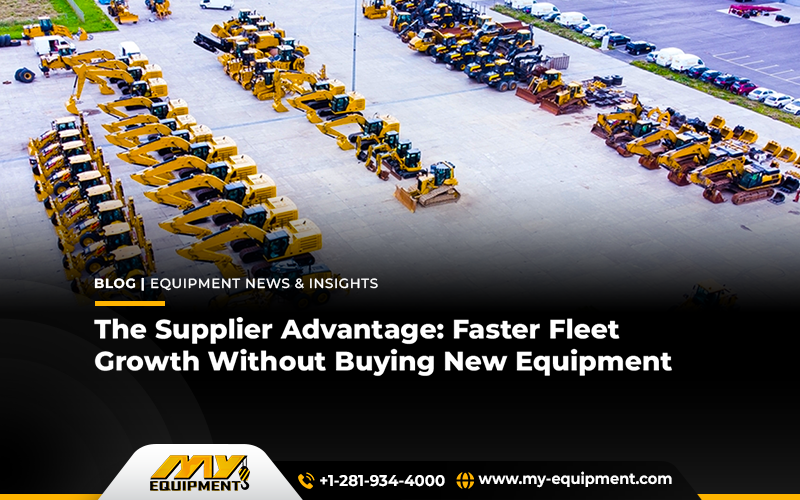
Growth is one of the key objectives for construction and equipment companies in terms of fleet. The more machines, the better the capacity, opportunities for a project, and the higher the revenue possibility. Meanwhile, growing their fleets with new equipment purchases can strain budgets, add risk to the financial equation, and leave long waits between the availability of new equipment.
It has altered the mindset of many businesses with regard to expansion. Companies are no longer satisfied with factory-new equipment, and are collaborating with heavy equipment suppliers to expand capacity more quickly. Suppliers provide growth opportunities, flexibility, and stock options to help businesses grow without having to make large capital investments.
Why Traditional Fleet Expansion Takes More Time
The advantages of purchasing new equipment have always been there, but when it comes to speed, it’s not necessarily one of them. Delays in production schedule, transportation, approvals, and equipment availability can cause delays in delivery. Once a business has been acquired, there is still a time needed for preparation and deployment.
All those delays result in lost opportunities. Projects keep moving forward as buyers wait for equipment to be delivered. Companies that rely on fresh sales might not be capable of reacting to unforeseen surges in demand or market fluctuations.
How Heavy Equipment Suppliers Change the Expansion Model
Heavy equipment manufacturers establish another means of fleet development. Rather than ordering equipment for production cycles, businesses are able to access equipment already available in suppliers’ inventory networks. This helps to avoid delays and aid faster decision-making about operations.
Suppliers are also providing increased equipment availability, by category and by spec. Businesses can choose construction machines that best suit the current needs, without having to change project plans around future deliveries. Improved access generates momentum that helps businesses to grow.
Access Creates More Value Than Ownership
Growth in fleet size is no longer solely reliant on fleet size. With the rising demand comes the focus on the availability and readiness of equipment, rather than on additional permanent equipment, in many companies today.
With this change, businesses can remain agile. Companies can scale through supplier networks and minimise ownership commitments for the long term. Equipment is no longer a sunk cost, but a resource to be used in the projects.
Used Equipment Plays a Bigger Role Than Before
The used equipment market is a factor in fleet growth strategies that are being implemented throughout the industry. More companies are seeing the value of used machines as a viable solution to expansion, instead of a short-term replacement for a new machine.
Heavy equipment suppliers help make this transition by sourcing, inspecting, and preparing equipment for resale. Buyers can access available equipment more quickly and have greater confidence in the quality of the equipment and their expectations of its performance.
Reducing Capital Pressure While Growing Operations
The cost of large equipment can constrain cash flow and make it difficult to allocate funds to other business needs. When too much capital is allocated to asset acquisition, rather than to operations and growth, the expansion becomes difficult.
An expansion supported by the suppliers is a more balanced approach. By expanding equipment capacity without tying up financial resources in staffing, maintenance, transportation, or future opportunities, companies can ensure they have the necessary resources to meet changing demands. This allows companies to meet evolving demands while maintaining financial resources for staffing, maintenance, transportation, and other future opportunities. This is a building that can frequently sustain longer-term growth.
Responding Faster to Changing Market Demand
It’s seldom that construction activity remains predictable. New contracts, seasonal fluctuations, or evolving business objectives can trigger a surge in demand. A sudden increase in demand can occur when a new contract is awarded, when there is a seasonal change, or when the business goal shifts. Businesses that are slow to respond may miss out on business opportunities, as others can respond faster with more equipment available.
Heavy equipment suppliers can alleviate this problem by making the process of getting equipment to market quicker. Greater access to equipment provides businesses with more confidence in undertaking more work and changing business plans.
Building Smarter Fleets Instead of Bigger Fleets
Today, fleet strategies are not simply about machine collection but about improving fleet utilisation. When making a new addition to the fleet, businesses are more likely to consider whether it will add value to the business.
Suppliers enable smarter decisions by providing equipment options to align with existing workflows and business goals. This will ensure the companies are efficient without the need to accumulate too many assets.
Why Supplier Partnerships Continue to Gain Importance
Buyers and suppliers are continuing to develop their relationship. Today, equipment suppliers are not just about the equipment; they’re about the value it brings to the company. They enable businesses to access and source the right products at the right time, and to tap into the right markets, offering operational flexibility.
Rather than a short-term fix, fleet growth without the purchase of new equipment is now a viable option. Having a flexible company and quicker access is crucial for some companies so that they can adjust to market changes effectively and continue to grow with confidence.
If you are looking for some trusted heavy equipment suppliers, then MY Equipment should be your first choice, as we deal in quality-inspected machinery from renowned brands at a reasonable price. Visit our website now to get the best machines and equipment service.
Don’t forget to subscribe to our YouTube channel for more equipment offers and insights into the industry.
 1400 Broadfield Blvd, Houston, TX 77084,
USA.

 WhatsApp +1-713-304-6013